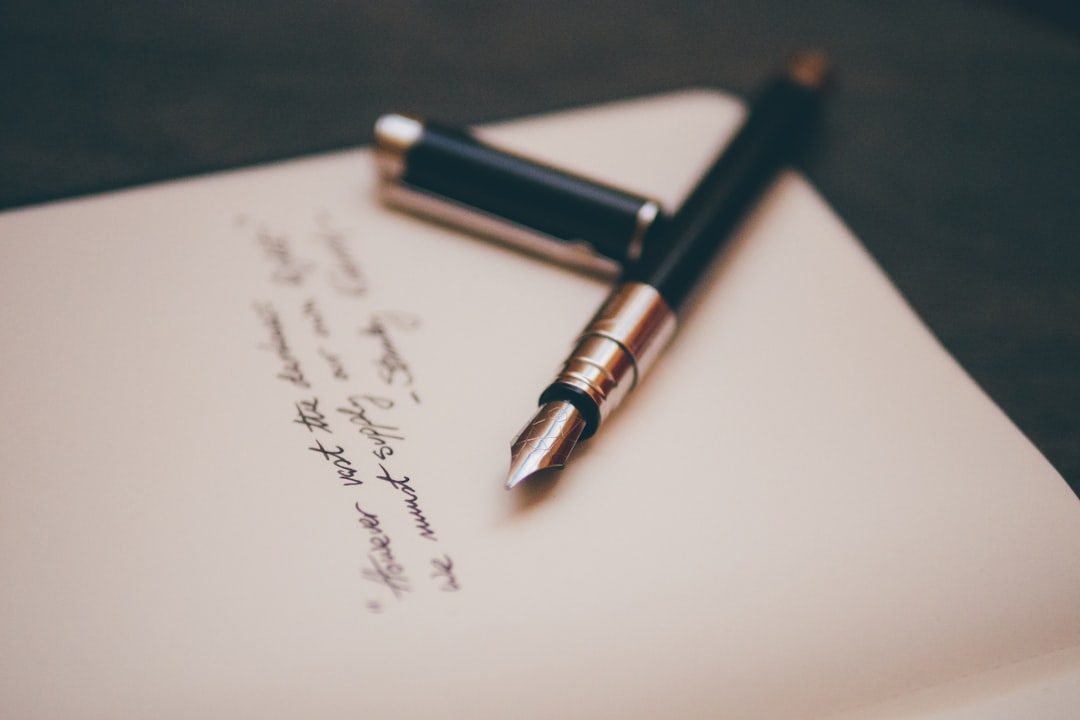
Photo by Álvaro Serrano on Unsplash
My first poetry professor handed back my manuscript with a single comment scrawled in red: "You're afraid of nothing." I thought she meant my themes were too dark, too confrontational. She meant something far more literal. I'd filled every inch of the page.
That conversation changed how I read poetry. Because once you notice white space, you can't stop seeing it. It's everywhere—in Mary Oliver's spare lines, in Anne Carson's radical use of the page, in the work of poets who understand that what you don't say matters as much as what you do. White space isn't absence. It's presence disguised as emptiness.
The Power of the Unwritten Word
Consider this fact: the average contemporary poetry reader spends more time staring at blank page than reading actual words. This isn't a flaw. It's the whole point.
When Sappho's fragments arrive to us, they don't arrive complete. We get pieces—a hand, a voice, a memory cut off mid-thought. For centuries, scholars treated these gaps as unfortunate casualties of time. But what if Sappho was onto something? What if the most devastating emotional moments are the ones where language breaks down entirely?
Contemporary poets have caught onto this secret. They've stopped treating white space as something that happens when you run out of things to say. Instead, they're using it as a primary material, like paint or clay. Anne Carson's "Autobiography of Red" proves this brilliantly—her use of spacing and silence transforms a classical myth into something that feels intimate and broken and achingly contemporary.
The white space does heavy lifting here. It makes the reader complicit. It forces you to complete the thought yourself, which means the poem lives differently in every reader's mind. There's no single interpretation because the poet handed you half-finished sentences and said, "You finish this."
Why Minimalism Became Maximum
Richard Serra, the sculptor, once said: "Drawing is not following a line on the paper—it is going through the paper." Poets learned this too. They realized that sometimes the most profound statements require the fewest words.
Look at what happened in poetry between 1970 and today. We moved away from the maximalist traditions—the Ginsberg howls and Lowell confessions—toward something quieter. Spartan. Breathtaking in its restraint. This wasn't laziness or diminished imagination. It was poets recognizing that contemporary readers move through language like we move through everything else: fast, distracted, overstimulated.
To cut through that noise, you don't shout louder. You whisper in a way that forces people to lean in close and listen.
The numbers tell part of this story. Poetry collections published between 2010-2020 average significantly fewer words than collections from the 1990s. But sales haven't dropped proportionally. People are craving these compressed, concentrated experiences. In an age where we consume thousands of words daily, a poem that says something essential in fifteen lines feels like a luxury item—something precious because it respects our time.
Louise Glück (who won the 2020 Nobel Prize in Literature) builds entire emotional architectures from small words in simple sentences. Her power comes from what she doesn't elaborate. She trusts the reader to understand that silence after "I didn't know what to say" contains multitudes.
The Line Break as Silence
Here's where it gets technical, but stay with me because this matters: a line break is forced pause. It's you, the poet, saying "stop here. Breathe. Sit with this."
This connects directly to what The Enjambment Revolution explores—how line breaks have become one of poetry's most precise instruments. When you enjamb a line (carry meaning across the break without natural pause), you're using white space to create tension. When you end-stop (complete a thought at the line break), you're using white space to create rest.
A single poem can contain both strategies, and the rhythm creates meaning. Think of it like music: white space is the rest, and the rests are what make the melody memorable.
This is why transcribing poetry into prose destroys it. You don't just lose the words; you lose the silences that shaped them. A poem is not the language plus the white space. It's an integrated whole where both elements are inseparable.
White Space as Resistance
There's something subversive about silence in a culture built on constant communication. Poets know this. That's why many experimental and marginalized poets use white space deliberately—not just as aesthetic choice but as political statement.
Billy-Ray Belcourt (a Canadian poet and critical theorist) uses sparse formatting and significant gaps in his work to reflect Indigenous disruption and discontinuity. The white space isn't decoration; it's documentation of a fractured history and a fractured present. Similarly, Asian American poets have engaged with white space to express what doesn't translate, what remains untranslatable, what colonialism tried to erase.
When you refuse to fill the page completely, you're saying: "Some things cannot be said directly. Some truths require absence to be understood."
Learning to Read the Silence
If you want to understand a poem, stop reading as fast as you can. Read a line. Stop. Look at where the poet put the line break. Read again. This time, notice what's on the next line. The white space isn't wasted real estate. It's the medium through which the poet communicates.
Try this with any contemporary poetry collection. Read three poems by the same author. Notice their pattern of white space. Does this poet bunch lines together for intensity, then space them out for reflection? Do they favor long lines with no breaks, creating a rushing feeling? Does the white space vary strategically throughout the poem?
Once you start asking these questions, poetry reveals itself as something architectural and intentional. Every gap is a choice. Every margin tells a story.
The ghost in the margin isn't absence. It's presence waiting for you to recognize it. And maybe that's the real revolution: poets teaching us that silence, when done right, speaks louder than anything we could write.
Comments (0)
No comments yet. Be the first to share your thoughts!
Sign in to join the conversation.