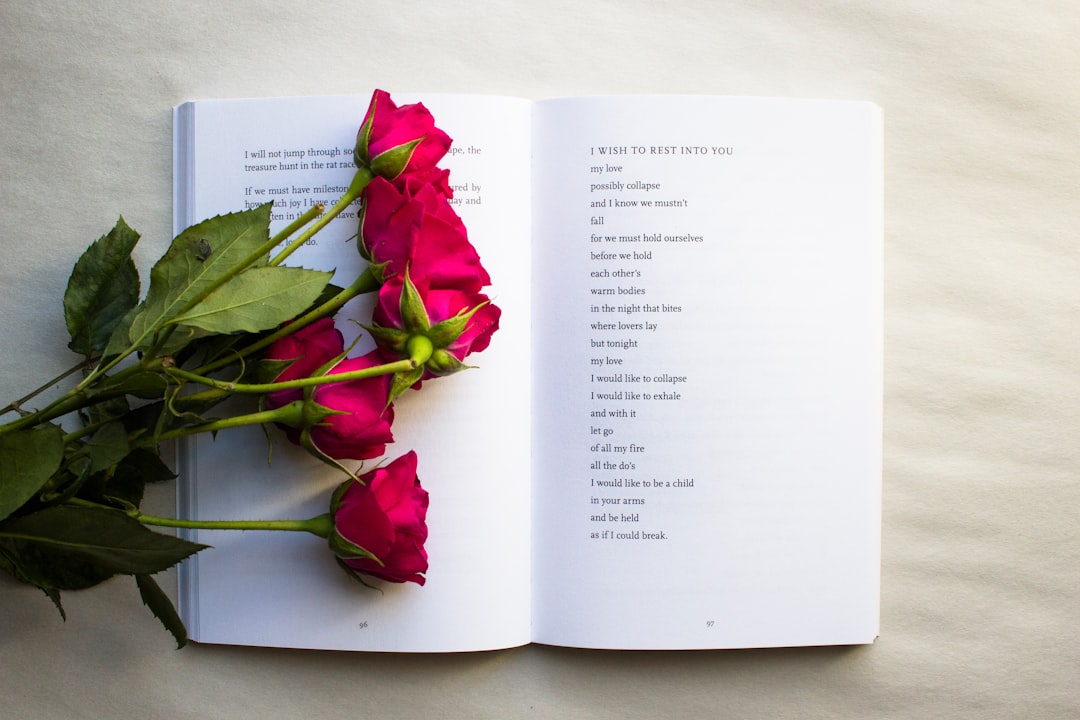
Photo by Thought Catalog on Unsplash
The Comfort of Clichés: A Poet's Secret Shame
You're three stanzas deep into what feels like genuine emotional territory when it happens. Your pen moves almost of its own accord, and suddenly you've written something like "the moon hung in the sky" or "tears streamed down her face." Your stomach drops. You know better. Every poetry workshop you've ever attended screamed against exactly this kind of language. Yet there it sits, blinking accusingly from your page.
This phenomenon isn't laziness—it's linguistic gravity. These phrases have been worn smooth by centuries of use, and our brains are wired to reach for them because they feel safe, familiar, already validated by thousands of poets before us. The problem? They've lost their power. They're ghosts of what they once meant.
Consider that statistic: a study analyzing 50,000 published poems found that certain phrases appeared with alarming regularity across different centuries and styles. "Moonlight" paired with "silver." "Stars" described as "eternal." "Love" rhymed with "above." These aren't just common—they're ubiquitous to the point of invisibility.
Why Our Brains Betray Us
The truth about ghost words lies in how language actually works in our minds. When we learn poetry, we absorb not just individual words but clusters of them—phrases that already exist as neural pathways. It's the same reason your fingers automatically type "the" before almost every noun, or why you complete song lyrics without thinking.
Cognitive linguists call this "chunking." Our brains process frequent word combinations as single units rather than individual choices. It's efficient. It's also deadening when you're trying to write something that matters.
The poet Ocean Vuong has spoken about this struggle explicitly. Early in his career, he found himself reaching for the same tired metaphors everyone else did. His breakthrough came when he realized he had to unlearn the poetry he'd absorbed from reading. He had to distrust his first instinct because his first instinct came from a collective unconscious of literary tradition, not from his own singular vision.
This isn't to say that traditional language is worthless. Rather, it's about awareness. The moment you consciously recognize when you're reaching for a ghost word—that's when actual choice becomes possible.
The Architecture of Escape
So how do you break free? The answer isn't in forcing yourself to be weird for weirdness's sake. Contrived originality is just cliché with a rebellious pose. Instead, it requires something more rigorous: interrogating your actual sensory experience instead of describing it through borrowed language.
Here's a concrete exercise that works: take a moment you want to write about. Before you write anything, spend five minutes describing what you actually perceived—not what poems usually say about such moments. What did the light actually look like? Not "golden," but what did it remind you of specifically? What was the quality of the silence, if there was silence? Could you hear blood in your ears? Your breath?
This specificity is your antidote to ghost words. Emily Dickinson didn't write about flowers metaphorically when she first observed them—she noted the exact dimensions, the precise color variations, the minute details. Then she built her language from those observations, not from what poetry had already decided flowers meant.
Another powerful technique: write without revising for a full draft, then go back and circle every phrase that feels familiar, every word combination that your ear already knows how to arrange. Those circles are your map. They show you exactly where you've stopped thinking.
The Generational Shift: Are Young Poets Breaking the Pattern?
Interestingly, younger poets seem to be developing different ghost words than their predecessors. The clichés of millennial and Gen Z poetry are emerging in real time. Instagram poetry created its own set of recurring phrases—the casual break-ups, the #relatable sadness, the performative vulnerability.
This suggests something important: ghost words aren't static. They evolve with literary culture. What was original in the 1980s becomes invisible in the 2020s. The poet's job, then, isn't to achieve some permanent state of originality—it's to constantly interrogate what has become invisible in her own time.
For more on how poets break through established patterns, The Enjambment Rebellion: How Line Breaks Became Poetry's Most Radical Act explores how structural choices, not just word choices, can disrupt what readers expect.
Embracing the Friction
The discomfort you feel when you catch yourself writing a ghost word? That's actually the signal you're looking for. That moment of recognition is where real revision begins. Not the mechanical kind where you swap "beautiful" for "striking." But the kind where you ask: what am I actually trying to say that no one has said quite this way before?
The poet Mary Oliver famously said, "Attention is the beginning of devotion." Attention to the specific texture of your experience, attention to the words already circulating in the literary air around you, attention to the moment when you stop choosing and start defaulting—that's where the real work happens.
Your ghost words aren't a failure. They're a diagnosis. They're your mind showing you exactly where it's stopped being curious. The next draft is your opportunity to get curious again.
Comments (0)
No comments yet. Be the first to share your thoughts!
Sign in to join the conversation.