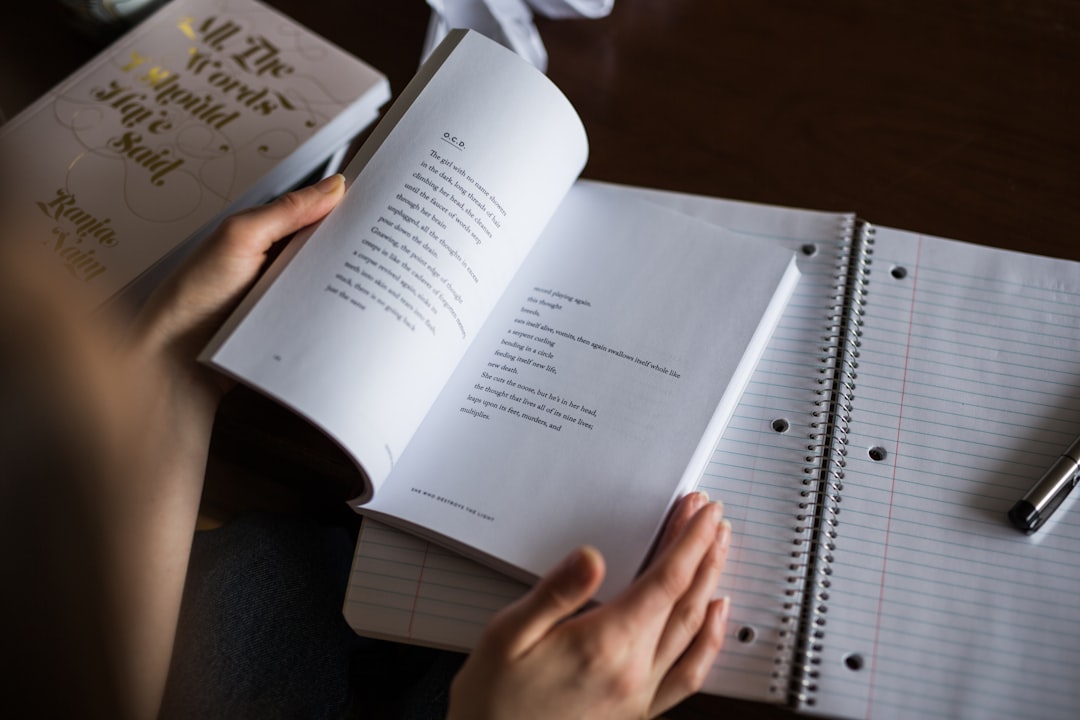
Photo by Thought Catalog on Unsplash
I once watched a poet friend spend forty-five minutes deciding whether to cut a single line. It was beautiful—genuinely beautiful. "The rain tastes like someone's old letters," it read. But it didn't belong. The poem had moved on without it, left it standing alone like a guest who arrived at the wrong party. She knew it had to go. She cried a little anyway.
This is the secret nobody tells you about poetry: the hard part isn't writing the brilliant line. The hard part is recognizing when your brilliant line has become a ghost haunting your poem, a beautiful thing that's preventing the actual poem from breathing.
The Tyranny of the Perfect Phrase
Here's the uncomfortable truth that emerges when you study revision manuscripts—and I mean actually study them, not just read the polished final versions. Poets cling to phrases with an almost pathological attachment. They're in love with the phrase itself, not with what the poem needs.
Ocean Vuong talked about this in an interview where he mentioned cutting an entire section of "Night Sky with Exit Wounds" that had taken him weeks to write. Not because it was bad. Because it was too good. It sparkled so brightly it distracted from everything around it, like a disco ball in a bedroom. The poem needed subtlety; the phrase demanded attention.
This happens constantly in workshop settings. A poet will defend a line fiercely, and every experienced writer in the room recognizes the signs: excessive explanation, desperate justification, the "but I worked so hard on it" defense that's really a cry for emotional validation. We've all been there. That line cost us something to find, and we want it to matter.
But poems don't care about your effort. They care about their own integrity.
The Mathematics of Emotional Honesty
What's fascinating is that this isn't about ego in the way we typically discuss it. It's actually about something more subtle: the difference between a line that's *clever* and a line that's *true*. Sometimes a line is remarkably clever—it demonstrates technical mastery, unexpected imagery, genuine wordplay—but it's emotionally dishonest in context. It tells a prettier story than the poem actually wants to tell.
Mary Oliver, in her essay collection "A Poetry Handbook," talks about how revision is the moment when the poem stops being about impressing people and starts being about actual communication. The phrases that survive aren't necessarily the most quotable ones. They're the ones that serve the poem's emotional architecture.
Consider the difference between these two potential lines in a poem about loss:
Version A: "Your absence has become the most reliable thing in my life."
Version B: "You're gone. The light still comes."
Version A is smarter. It has paradox, irony, that satisfying intellectual twist. Version B is smaller, quieter, almost embarrassingly simple. But which one tells the truth about grief in a way that actually lands in the chest?
The poets who produce lasting work understand this distinction. They're not afraid to kill the clever line if the simpler one says what actually needs saying. This is what separates the poets whose work you remember versus the ones whose techniques you admire.
Why Even the Celebrated Ones Struggle
Louise Glück won the Nobel Prize for Literature in 2020. She's possibly the most technically accomplished living poet. And yet, in her notebooks, you can see her crossing out, revision after revision, second-guessing herself constantly. Not because she lacks confidence in her abilities, but because she understands something crucial: the better you get at writing, the harder revision becomes.
An amateur poet might write ten mediocre lines and cut three of them. A professional poet writes ten good lines and cuts eight of them, because they understand that the eight other good lines are actually preventing the two real lines from shining. The stakes get higher. Your instinct gets more refined. Your attachment to clever phrases actually intensifies because you've trained yourself to find them.
The difference between a published poet and an aspiring poet often comes down to this one skill: the willingness to murder your own darlings. Not occasionally. Constantly. Every poem, every revision cycle.
Tobias Wolff, primarily known as a fiction writer but someone who understands prose rhythm in ways that border on poetic, has said that revision is where you discover what you actually meant to say. The first draft is exploration. Revision is truth-telling. And truth-telling requires ruthlessness.
The Counterintuitive Path Forward
So what do you do with this knowledge? How do you actually apply it to your own work?
First, accept that the line you're most protective of is probably the one that needs to go. This isn't always true, but it's true often enough to be a useful diagnostic tool. If you find yourself defending a phrase, explaining why it works, justifying its place in the poem—that's your signal that something's off.
Second, separate the writer from the line. The line isn't you. Its deletion isn't a referendum on your talents. You wrote it; you can write other things. Better things. Harder things. The line served its purpose—it got you to the next line, the real line, the line that actually belongs.
Third, read your work aloud and listen for where your own voice stops and the performed version begins. That's often where the false notes are hiding—the places where you're showing off instead of telling truth.
Finally, understand that this process never ends. You don't reach a point where you're too good to have to revise ruthlessly. If anything, the opposite is true. The better you become, the more thoroughly you have to interrogate every choice, every phrase, every comma's reason for existing. The Enjambment Revolution: How Line Breaks Became Poetry's Most Dangerous Weapon explores similar ideas about how technical choices can either serve or sabotage emotional truth.
The Beautiful Conclusion That Isn't
Here's the thing: my friend did cut that line about the rain tasting like old letters. Three months later, she told me she couldn't even remember what it was. She'd moved on. The poem had moved on. And what remained was stronger for the absence.
That's the real secret nobody tells you. The ghosts we kill in our poems don't haunt us. They free us. Every beautiful phrase you're willing to sacrifice is space you've opened for something truer, something harder, something that will actually survive the reading of it. That's where real poetry lives—not in the clever turns, but in the willingness to be simple when simplicity is what's true.
The next time you write something brilliant, I want you to mark it for potential deletion. Not because it's bad. Because it might be too good for its own context. Let that possibility sit with you. Let your ego feel the discomfort. Then decide, from a place of real artistic integrity rather than fear, whether it stays or goes. That's where you'll find your actual voice.
Comments (0)
No comments yet. Be the first to share your thoughts!
Sign in to join the conversation.