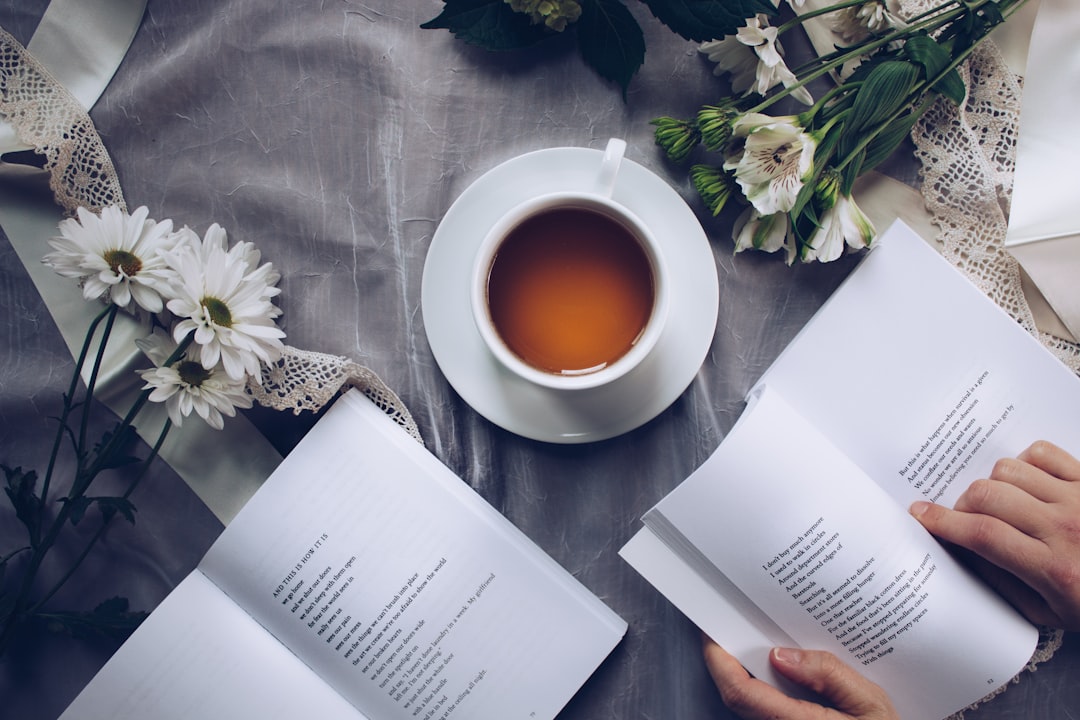
Photo by Thought Catalog on Unsplash
There's a moment in Ocean Vuong's poem "Nocturne" where a line ends mid-thought, leaving you suspended. Your eye moves to the next line, and suddenly the meaning shifts entirely. That's enjambment—the practice of running a sentence or phrase across multiple lines without stopping at the line break. It's not new, but lately, it feels revolutionary.
Walk into any contemporary poetry reading, flip through a recent collection, and you'll notice something: poets are obsessed with breaking their lines in increasingly audacious ways. They're not just following grammar anymore. They're weaponizing the space between lines, using it to control pacing, create surprise, and force readers into a physical experience of emotion. It's one of the most underrated techniques in modern poetry, and it's transforming how we read.
When Your Eyes Betray Your Expectations
Let's start with something simple. When you read a poem on a page, your eye doesn't just process words—it processes anticipation. A line ending creates a tiny pause, a moment of closure. Most traditional poetry respects this. You reach the end of a line, grammatically and thematically. It's satisfying. Controlled. Predictable.
Enjambment destroys that contract.
Consider this example from Sylvia Plath's "Morning Song": "Love set you going like a fat gold watch." If Plath had written it as plain prose, the image works fine. But she breaks it across lines: "Love set you / going like a fat / gold watch." Suddenly, "going" becomes its own thought. The heaviness of "fat gold" lands harder because it's separated. Your reading experience mimics the speaker's fragmented emotional state.
This is the power poets discovered. Your brain anticipates closure at each line break. When it doesn't come, there's a small jolt. Multiply that across an entire poem, and you're not just reading—you're physically experiencing the poet's intended rhythm. You're breathing how they want you to breathe.
The Politics of Breaking Lines
Here's something most people don't realize: enjambment isn't neutral. It's deeply political.
Throughout the 20th century, experimental poets used violent enjambment to resist traditional forms. Free verse poets embraced it as liberation from restrictive meter and rhyme. But contemporary poets—particularly poets from marginalized communities—have weaponized enjambment in new ways. They use it to resist narrative closure, to refuse easy answers, to embody the fragmentation of identity itself.
Think about Claudia Rankine's "Citizen," where enjambment creates a kind of textual unease that mirrors the constant micro-aggressions she documents. The breaks aren't stylistic flourishes. They're formal expressions of interrupted lives, of words cut off mid-breath, of thoughts that can't be completed because reality keeps interrupting.
Or consider the work of Natalie Diaz. Her poems break lines in ways that feel almost violent, forcing English—a language she's claimed from colonization—to stumble and reformulate itself. The enjambment becomes an act of resistance, a refusal to let meaning settle comfortably.
This matters because it shows how a technical choice becomes an ideological stance. When you break your lines radically, you're saying something about control, about who gets to finish their sentences, about whose narratives are allowed to complete.
Your Brain on Broken Lines
Neuroscientists haven't extensively studied poetry reading (a genuine tragedy), but what we know about reading and comprehension offers clues. Your brain doesn't process language linearly. It predicts. It creates patterns. It anticipates closure.
When a poet breaks a line mid-clause, they create what some linguists call "garden path effects"—moments where your brain's prediction goes wrong, forcing a reanalysis. This isn't frustrating (well, not entirely). It's actually how we remember things. Memory forms strongest around disruption, around moments that violated our expectations.
That's why poems with radical enjambment stick with you. Not because they're beautiful (though they often are), but because your brain had to work harder to process them. That cognitive effort creates deeper encoding. You remember them because you had to rebuild your understanding multiple times.
Frank O'Hara understood this instinctively. His poems seem casual, conversational, like overheard thoughts. But his enjambment is precise and calculated. A phrase breaks where it surprises you most, not where grammar demands. Read "The Day Lady Died" aloud and notice how the breaks create a jazz-like rhythm—syncopated, unexpected, yet somehow inevitable in retrospect.
Breaking Into the Future
What's fascinating about contemporary poetry is how enjambment has become even more radical in the age of screens. Poets like Victoria Chang and Danez Smith use line breaks that create visual patterns on the page. Some poets intentionally create ambiguity—where a word could belong to the line above or below, creating multiple simultaneous meanings.
Digital poetry has exploded these possibilities further. When a poem exists on a screen that might resize, reflow, or transform based on device, enjambment becomes even more fluid. The line break becomes uncertain—will the next word appear on the same line? The next one? This uncertainty mirrors contemporary anxiety perfectly.
There's also the TikTok phenomenon, where poets like Rupi Kaur and Amanda Gorman use line breaks that function almost like pacing in film. Each line becomes a shot, a moment to absorb before the next image. The platform itself has educated millions in enjambment's power, even if they don't know the technical term. They just know that the pause feels necessary, that the visual arrangement carries meaning.
The Craft Beneath the Magic
Here's what most people get wrong about enjambment: they treat it like an accident, a poetic flourish, something vaguely artistic. Real poets know better.
Every line break is a decision. Some poets plan them meticulously, using a grid system or careful notation. Others discover them through revision, reading aloud, listening for where the breath naturally breaks. Many do both.
The best contemporary poems break their lines with mathematical precision disguised as spontaneity. A line break might occur after the most powerful word (making you sit with it alone), or before the most powerful word (building anticipation), or in the middle of a metaphor (forcing you to hold two meanings simultaneously). Each choice cascades through the poem's meaning.
If you want to understand this at a cellular level, try rewriting a poem by removing all enjambment—make it prose or put it in strict couplets. The poem dies. What seemed essential becomes transparent. The enjambment wasn't decoration. It was the skeleton.
Understanding enjambment transforms how you read. You stop skimming. You respect the page as a visual field, not just a vehicle for words. You recognize that where a poet chooses to break a line is as important as what words they've chosen. You become attuned to the physical experience of reading, not just the intellectual content.
This is why enjambment matters. It's not technical pedantry for MFA students. It's a direct line between a poet's intention and your nervous system. It's how we create the rhythm of human consciousness on a page. And right now, some of the best poets writing are discovering new ways to break our lines—and in doing so, break us open.
Want to understand how poets are revolutionizing their craft? Check out why poets are suddenly writing about their day jobs—contemporary poetry is changing in radical ways.
Comments (0)
No comments yet. Be the first to share your thoughts!
Sign in to join the conversation.