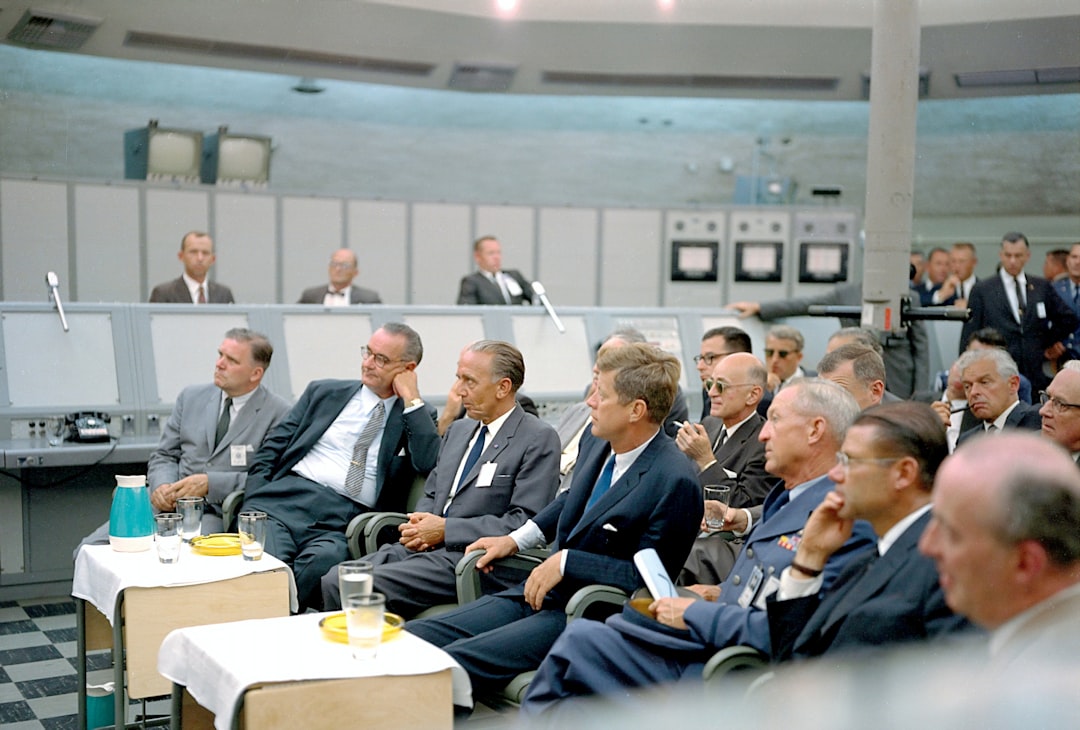
Photo by History in HD on Unsplash
Last Tuesday, Governor Ron DeSantis signed a bill allowing Florida to take over struggling school districts without local approval. In California, Governor Gavin Newsom declared a homelessness emergency that gave him sweeping powers to bypass environmental reviews and speed up housing construction. Meanwhile, in Texas, Greg Abbott activated the National Guard to police the southern border—a move that would have been unthinkable for a governor twenty years ago.
Nobody's marching in the streets. The national media barely blinks. Yet these aren't minor administrative tweaks. They represent a fundamental shift in American power dynamics that deserves serious attention.
The Great Power Migration Upward (And Sideways)
We've spent decades obsessing over presidential power grabs. We've watched Congress abdicate responsibility through endless continuing resolutions and emergency declarations. But while everyone was watching the federal government, something equally significant happened: governors started acting like presidents of their own countries.
This isn't entirely new. Governors have always wielded considerable authority. But the speed and scope of executive action at the state level has accelerated dramatically since 2020. The pandemic gave executives across the country—both Democratic and Republican—experience using emergency powers. They liked it. They kept it.
New York Governor Kathy Hochul extended her emergency declaration for subway crime 15 times, allowing her to bypass standard procurement rules and spend money with minimal oversight. Florida's DeSantis created his own police force, the Office of Election Crimes and Security, investigating alleged voting irregularities—effectively creating state-level voter suppression infrastructure. These aren't hypotheticals. These are happening right now, funded by your tax dollars, with minimal legislative input.
Why Congress Became a Bystander in Its Own Democracy
Here's the uncomfortable truth: state legislatures have largely surrendered to their governors, either through explicit delegation or negligent oversight. When Arizona's legislature wanted to reassert itself during the pandemic, Governor Doug Ducey simply ignored them. When Texas lawmakers tried to constrain Abbott's emergency powers, he used his veto to punish the legislative session itself—something most people don't even know governors can do.
The reasons for this power shift are partly structural. In many states, the legislature meets part-time—often just a few months per year. Governors, by contrast, have permanent staffs, 24/7 authority, and the machinery of state government at their disposal. When crises hit (and they hit constantly now), legislatures can't mobilize fast enough. So governors act. And once they act, reversing executive action is exponentially harder than preventing it initially.
There's also a personal factor. Governors have become celebrity politicians in ways that state legislators simply aren't. DeSantis, Newsom, Abbott—these names mean something. They appear on national news. They run for president. State senators, by contrast, are anonymous figures who rarely make headlines. This concentration of attention and political capital naturally flows toward the executive.
The Ideological Acceleration
What makes this particularly concerning is how governors are weaponizing their new powers along ideological lines. Blue state governors are using executive authority to expand abortion access and immigrant protections. Red state governors are using it to restrict voting access and intensify immigration enforcement. Both camps are essentially saying: "The legislature is too slow, too divided, too compromised. We'll just do this ourselves."
Consider the abortion fight post-Dobbs. Rather than waiting for legislatures to act, governors in blue states immediately used executive orders to shield abortion providers and protect patient data from red state prosecutors. Governor Josh Shapiro in Pennsylvania essentially created a de facto sanctuary state for abortion access before the legislature even convened. This was bold. It was also executive unilateralism.
On the red side, Governor Greg Abbott in Texas didn't just enforce existing abortion restrictions—he expanded them through executive action, directing law enforcement to investigate abortion providers based on new interpretations of state law. He didn't ask the legislature for permission. He just did it.
The problem isn't whether you agree with these policies. The problem is the method. Democracy depends on legislative deliberation, debate, and accountability. Executive orders bypass all three.
What This Means for Democracy (Spoiler: It's Complicated)
The irony is that governors' executive power grab actually makes state governance more efficient in some ways. Major policy changes happen faster. Red tape gets cut. Results arrive quicker than they would through normal legislative processes.
But efficiency isn't the highest democratic value. Legitimacy is. When one person, no matter how popularly elected, can reshape policy without legislative input, democracy becomes plebiscitary—rule by popular figure rather than rule by law. It's government by personality rather than process.
States with divided governments are experiencing this most acutely. In Wisconsin, Democrat Governor Tony Evers faces a Republican legislature that opposes him on nearly everything. His solution? Executive orders on everything from education policy to environmental protection. The legislature responds with lawsuits. Nothing gets resolved. Government becomes theater.
There are also practical consequences. When governors govern primarily through emergency declarations and executive orders, those policies are fragile. The next governor can simply reverse them. There's no durable legislation, no settled law, no institutional momentum. Everything is temporary, dependent on whoever occupies the governor's mansion.
The Path Forward
This isn't a problem with easy solutions. You can't really constrain executive power through executive action. That would just be another governor doing the same thing. The real answer requires legislatures to reassert themselves—to meet more frequently, to pass actual laws rather than delegating authority, to fund their own operations so they're not dependent on the governor's budget.
Some states are trying. Colorado's legislature now meets year-round. North Carolina has been slowly reclaiming powers that previous governors accumulated. But these are exceptions, not the rule.
For voters, the implication is clear: your governor is more powerful than you probably think. When you're evaluating candidates for that office, remember that you're not just choosing an administrator. You're choosing someone who, in practice, will likely wield quasi-legislative authority through executive action. That's a much bigger decision than most people treat it.
If you want to understand how state executives are reshaping democracy at a more fundamental level, check out "The Silent Coup: How State Legislatures Are Quietly Rewriting Democracy" for a broader view of how state-level politics are reshaping the national balance of power.
The governor's office is no longer just about ribbon-cuttings and disaster response. It's become the primary locus of power in American politics. And until we acknowledge that reality, we'll keep being surprised by it.
Comments (0)
No comments yet. Be the first to share your thoughts!
Sign in to join the conversation.