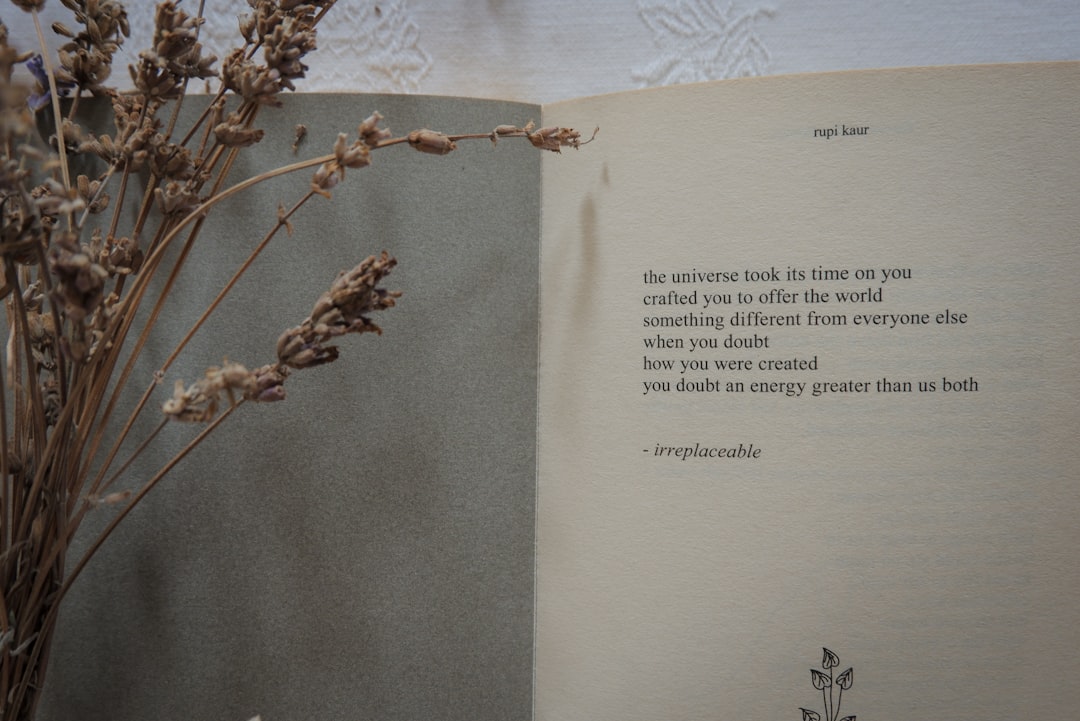
Photo by Giulia Bertelli on Unsplash
You've probably felt it without knowing what to call it. That moment in a poem when the ground shifts beneath your feet. When the careful argument collapses. When everything you thought was true gets questioned, reframed, or shattered entirely. That's the volta at work, and it's one of poetry's most electrifying moves.
The volta—Italian for "turn"—is a rhetorical shift that happens when a poem pivots from one idea to its opposite or complements it with something unexpected. It's not just a technique. It's the moment a poem stops being clever and starts being true.
The Architecture of Transformation
Let's start with the obvious place: the sonnet. Shakespeare's sonnets are master classes in the volta. Take Sonnet 18, where he begins by questioning whether summer is the best season to compare his lover to. For twelve lines, he argues that his lover is actually superior to summer—more temperate, more lovely. Then comes line 13, and everything changes: "But thy eternal summer shall not fade." That single word, "but," pivots the entire poem from comparison to immortalization. The sonnet form doesn't require this turn, but Shakespeare understood that the volta gives the sonnet its skeleton, its reason for existing.
The volta in a sonnet typically appears in the final couplet (in Shakespeare's version) or at line 9 (in Petrarchan sonnets). The structure itself invites the turn. Octave proposes something; sestet responds, questions, or complicates it. But here's what's fascinating: the volta doesn't care about form. You'll find it in free verse, in prose poetry, in villanelles and haikus and everywhere in between.
Where the Magic Actually Happens
The volta works because it mirrors how human consciousness actually operates. We think in straight lines until something forces us to reconsider. We build arguments, relationships, and narratives on certain assumptions. Then reality intervenes. A diagnosis arrives. A friend says something that changes everything. We realize we've been wrong.
In Mary Oliver's "The Journey," the volta might be the moment when the speaker realizes that everyone else—even those closest to her—cannot tell her where to go. "It was already late / in the day when you realized / what you had to do." The poem has been building toward something, and then it shifts. The journey belongs only to you. No one else can walk it. That turn from external to internal, from seeking permission to claiming agency, is what makes the poem matter.
Or consider Sharon Olds' "I Go Back to May 1937," which begins with the speaker watching her parents at their college reunion, before they were married, before they created her. For most of the poem, she contemplates what she might tell them about the unhappy marriage to come. Then, devastatingly, she realizes she can't warn them away because if she did, she would never exist. The volta isn't just a shift in thought—it's a shift in the entire ethical dimension of the poem. What seemed like a straightforward act of love (warning them) becomes an impossible contradiction.
The volta That Isn't What You Think
Here's where it gets tricky. Not every shift is a volta. Sometimes a poem just changes direction because the poet got bored or ran out of ideas. A real volta has weight. It changes the meaning of everything that came before. The first twelve lines of a sonnet aren't erased by the couplet; they're recontextualized by it.
Some poets use multiple voltas. Adrienne Rich's "Storm Warnings" builds to one turn, but then another one follows, complicating the first. It's like watching someone change their mind in real time, which is exactly what poetry should do—it should show us thinking happening.
The volta can also be subtle. It doesn't always announce itself with conjunctions like "but" or "yet." Sometimes it's just a change in tone. A shift from observational to emotional. A move from second-person address to first-person confession. In these quieter voltas, the reader has to do more work, which is precisely why they're so satisfying.
Finding Your Own Volta
If you're writing poetry and want to incorporate a volta, resist the urge to make it too obvious. The best voltas feel inevitable in retrospect, even though they surprise you in the moment. Ask yourself: what assumption have I been building in this poem? What's the opposite of that assumption, or what complicates it? Where's the place where certainty breaks down?
Many poets find the volta by accident. They're writing along, following one thread, and suddenly they discover a contradiction or a deeper truth hiding underneath. That's when you've got something. That's when a poem stops being exercise and becomes experience.
The volta is also worth studying in relation to line breaks and enjambment, which can amplify the shock of a turn or delay its recognition. The volta and the line break together can create a one-two punch that hits harder than either technique alone.
Why This Matters Now
We live in an age of fixed positions. Everyone's decided. Everyone's certain. Poetry that models the volta—that shows a mind changing, a perspective shifting, certainty dissolving into something more complex—is more radical than it might appear.
When you read a poem with a genuine volta, you're watching someone think. You're watching them discover something they didn't know they believed. That's the real power. Not the technique itself, but what the technique allows: the performance of human consciousness in its most honest form, changing course mid-thought, finding new ground beneath the feet.
Comments (0)
No comments yet. Be the first to share your thoughts!
Sign in to join the conversation.