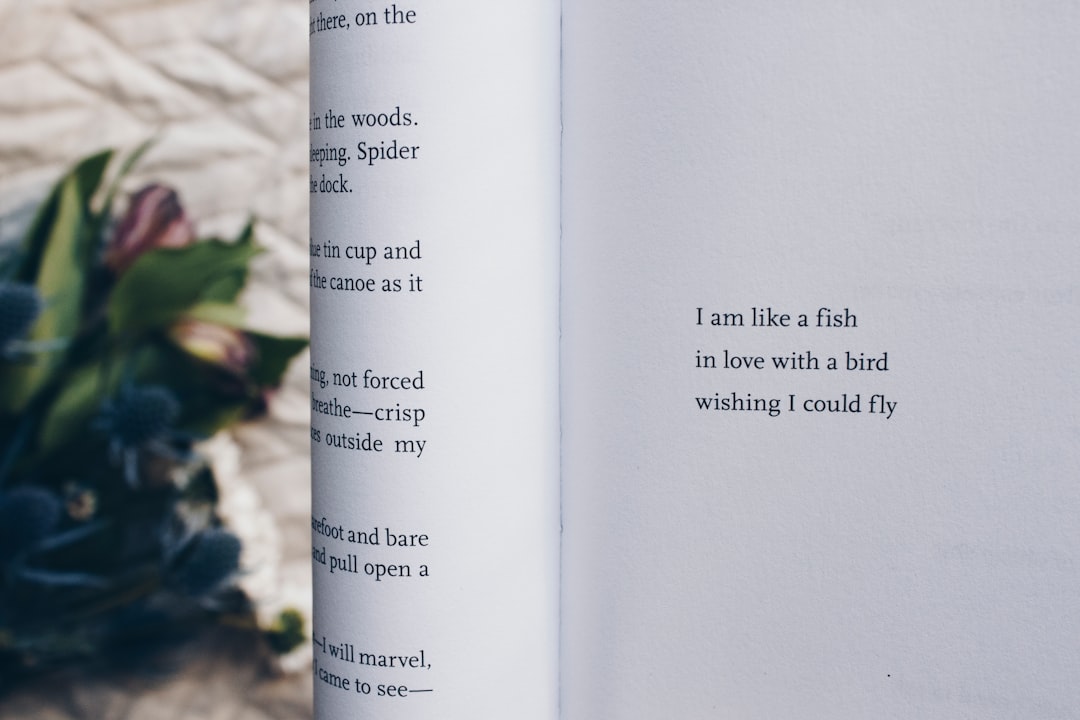
Photo by Thought Catalog on Unsplash
Last week, I watched a student read her poem aloud three times. The first two readings fell flat. On the third attempt, something clicked. Her voice shifted at line nine. Her body language changed. The poem, which had been meandering through observations about rain, suddenly pivoted into something devastating about grief. That moment—that invisible hinge—is what we call the volta, and it's one of the most misunderstood and underutilized tools in contemporary poetry.
Most poets know the volta exists. They've heard teachers mention it. But knowing about something and understanding how to wield it are entirely different propositions. The volta isn't decorative. It's structural. It's the moment when a poem stops being one thing and becomes another, and when executed well, it makes readers feel like they've been physically moved.
What the Volta Actually Does (And Isn't)
Let's clear up the confusion first. A volta isn't just a rhetorical turn or a moment where you change the subject. That's like saying a chess move is just moving a piece. Technically true, but it completely misses the point.
The volta is an argument with itself. It's a reversal, a revelation, or a sudden recontextualization that makes everything you've read before mean something different. The poem sets up expectations—emotional, thematic, or imagistic—and then the volta collapses them, expands them, or inverts them entirely.
Consider Shakespeare's Sonnet 73, probably the most famous volta in English poetry. The first twelve lines establish the speaker as an aging man, comparing himself to autumn, twilight, and dying fires. It's melancholic. It's resigned. And then the volta hits in the final couplet: "This thou perceiv'st, which makes thy love more strong, / To love that well which thou must leave ere long." Suddenly, the entire poem isn't about decline—it's about the paradoxical power of loving something precisely because it's temporary. The volta doesn't add information. It reorders the emotional and philosophical weight of everything preceding it.
This is crucial. Beginning poets often treat the volta like a plot twist in a mystery novel—they save information for the final moment to shock the reader. That's not a volta. That's just misdirection. A true volta works because the emotional or intellectual ground shifts, not because facts are withheld.
Where the Volta Lives (And Why Structure Matters)
The volta doesn't live in a specific line number. This is where poets get trapped by formalism. Yes, in a Shakespearean sonnet, the volta traditionally arrives at line 13. In a Petrarchan sonnet, it lands between the octave and sestet, at line 9. But these conventions exist because they work psychologically, not because they're rules carved in stone.
What matters is proportion and reader expectation. In a fourteen-line poem, a volta at line nine gives you enough space to establish something before you dismantle it, and enough space afterward to explore the implications. If your volta arrives too early, it feels premature. Too late, and it feels like an afterthought.
Free verse poets have an advantage here—and a disadvantage. Without the scaffolding of form, you have complete freedom to place your volta wherever it lands most naturally. But you also have no safety net. The reader has no formal expectations to help guide them toward the turn. You have to earn the volta through pacing, rhythm, and accumulated emotional weight.
Look at Ocean Vuong's "Night Sky with Exit Wounds." The poem begins in a domestic space, seemingly simple. But around the midpoint, the syntax fractures. The familiar becomes strange. Memory collapses into present moment. The volta isn't announced. It arrives quietly, almost imperceptibly, through a shift in how language itself behaves. That's sophisticated. That's control.
The Three Types of Volta (And How to Deploy Each)
Not all voltas are created equal. Understanding the different species helps you choose the right tool for your poem.
The Reversal Volta is the most dramatic. The poem says one thing, and then the volta says the opposite. Dickinson's "Hope is the thing with feathers" spent her entire poem praising hope's persistence, then—wait, that's not a reversal. Bad example. Better: Sharon Olds' "The Dead and the Living" moves from describing the dead (her father's generation) as absent and ghostly to recognizing that the living are complicit in their absence. The direction flips.
The Revelatory Volta doesn't reverse; it illuminates. The poem has been showing you pieces of a puzzle, and the volta steps back to reveal the complete picture. You see the same elements, but suddenly you understand their relationship to each other. This is what happens in Sylvia Plath's "Mad Girl's Love Song"—the observations mount, and then the volta reveals that none of it happened the way we've been reading it.
The Expansion Volta takes something small and suddenly enlarges its significance. The poem might begin with a personal anecdote, and the volta extracts a universal principle from it. Or vice versa—it starts with something abstract and grounds it in lived experience. This creates a dizzying shift in scale.
Each requires different pacing. A reversal needs momentum—you're asking the reader to believe the opposite of what they've accepted. A revelation needs accumulation—layers building until the pattern becomes visible. An expansion needs a moment of pause, a breath, before the view widens or narrows.
Why Your Poem Probably Needs One
Not every poem requires a volta. Some poems move through description, observation, or argument without needing that sharp turn. But most poems that fail to move readers are missing this element. They're poems that say something true but never transform that truth into something that changes you.
Here's what I tell students: if your poem ends the same way it began—emotionally, intellectually, spiritually—why should anyone finish reading it? A poem without a volta is just a longer way of saying what you could say in prose.
This doesn't mean the volta has to be obvious. The volta's power often relies on subtle structural choices, including how lines break and where emphasis falls. The volta can arrive so quietly that readers don't consciously notice it—they just feel the poem suddenly weigh more, mean more, shimmer with new significance.
The next time you write a poem, ask yourself: where does this poem argue with itself? Where does the ground shift beneath the reader's feet? If you can't identify that moment, your poem might be alive, but it probably isn't awake. The volta is what wakes it up.
Comments (0)
No comments yet. Be the first to share your thoughts!
Sign in to join the conversation.