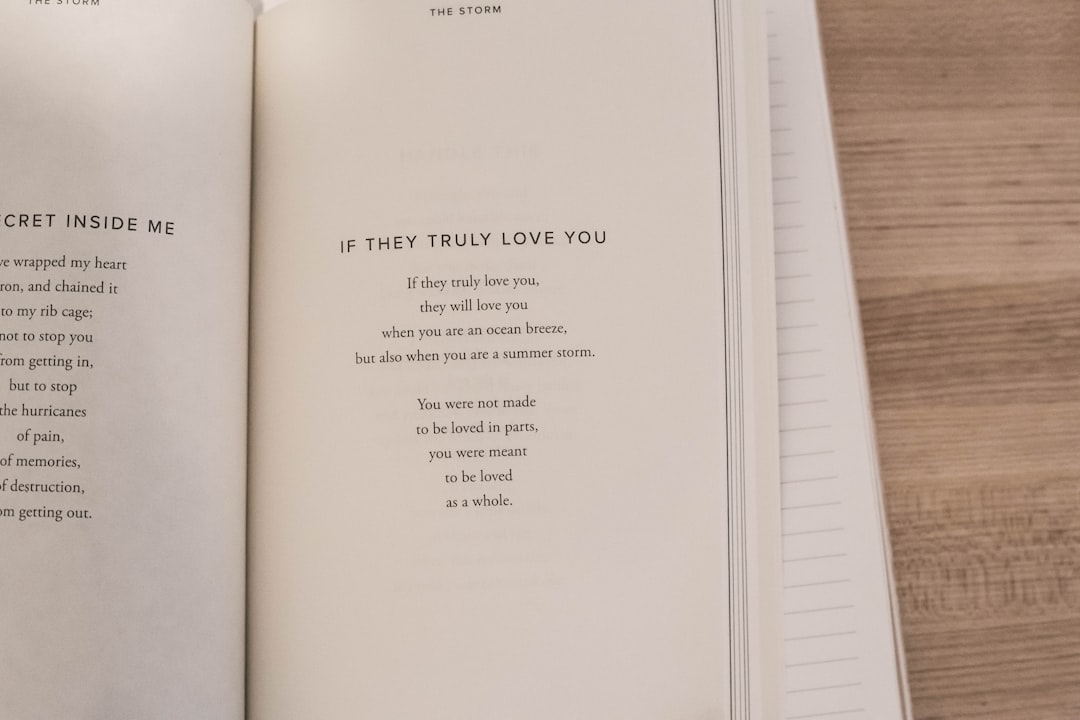
Photo by Thought Catalog on Unsplash
Last spring, a student approached me after a workshop session looking genuinely distressed. She'd written a devastating poem from the perspective of a woman watching her husband leave. The piece was visceral, brutal, honest. When I asked if she'd drawn from personal experience, she went pale. "No," she whispered. "I made it up. Does that make me a liar?"
This question haunts every poet eventually. We're taught that poetry must be authentic, raw, pulled from the bone. Yet we're also told to invent, to imagine, to become someone else entirely. The persona—that invented speaker who isn't quite you—sits at this uncomfortable intersection. And frankly, most of us handle it badly.
The Confusion Starts With Confessional Poetry
The 1950s and 60s gave us Sylvia Plath, Anne Sexton, and Sharon Olds. These poets bled onto the page with such shocking directness that we collectively decided poetry equaled autobiography. Plath's "Daddy" felt like a document from her actual therapy sessions. Sexton's "Her Kind" read like a journal entry written in fury at 3 AM.
Here's the thing everyone forgets: even these poets were creating personas. Plath wasn't literally addressing her dead father with quite that theatrical grandeur in private. She was constructing a speaker—a heightened version of her own anger, yes, but still a construction. The genius lay in making the construction feel so real that readers forgot they were reading art.
We inherited the assumption without inheriting the technique. Now poets either swing too far toward pure autobiography (boring, honestly—your actual life is rarely as interesting as you think it is) or completely away from it, creating speakers so distant from themselves that the work becomes bloodless intellectualism.
What Actually Happens When You Become Your Speaker
Robert Browning understood something crucial. His dramatic monologues gave him permission to become murderers, saints, obsessives, and fools. In "Porphyria's Lover," he doesn't confess to strangling anyone. He creates a speaker who does, and suddenly he can explore jealousy and possession and the thin line between love and violence without writing autobiography.
The persona is a disguise that reveals rather than conceals. By pretending to be someone else, you get to say truths you couldn't say as yourself.
When you write in first person as your actual self, you're constrained by your actual life, your actual relationships, your actual reputation. You worry about your mother reading it. You soften the anger because you'll see your ex at the grocery store. But when you create a speaker—even a speaker very close to yourself—something magical happens. You get plausible deniability. You get artistic freedom. You get to be honest.
Consider Ocean Vuong's "Night Sky With Exit Wounds." Many readers assumed these poems were straight autobiography—a queer Vietnamese-American poet writing about his family's trauma. In interviews, Vuong has been careful to note that while the work is deeply personal, it's also constructed. The speaker is a persona, even when he shares Vuong's gender, sexuality, and ethnic background. That distinction matters because it allowed Vuong to amplify certain feelings, compress time, invent dialogue, and reshape memory in service of emotional truth rather than factual accuracy.
The Three Types of Personas You'll Actually Use
First, there's the barely-disguised persona. This is Plath territory. You're largely yourself, but you've cranked the emotional intensity to eleven. You've given yourself permission to exaggerate, to be theatrical, to say the worst thing you thought but would never say aloud. Many beginning poets live here comfortably. It works if you have something to say.
Second, there's the adjacent persona. You're writing as someone recognizably similar to yourself but with one crucial difference: different gender, different decade, different trauma. Louise Glück does this brilliantly. Even in her most personal work, there's a slight remove. The speaker might be you-but-younger, you-but-from-another-era, you-but-with-a-different-wound. This gives you the safety of distance while maintaining emotional authenticity.
Third, there's the radically different persona. You're not yourself at all. You're writing as a historical figure, a fictional character, a completely invented person. This is where poets often get scared. We worry it's "not personal enough," that we're hiding. But consider Ai's "Riot Act, 11:59 PM," where she channels the voice of a man cornering a woman in an elevator. The poem's power comes entirely from Ai's refusal to be herself, her willingness to become the perpetrator and make readers complicit in his psychology.
Why Most Poets Botch This
The biggest mistake? Forgetting that your persona needs a voice. Too many writers create a different character but then have them speak in the poet's own language, with the poet's own concerns, using the poet's own metaphors. You've created a persona on paper while abandoning one on the actual page.
A real persona talks differently. They care about different things. They notice different details. They have obsessions, speech patterns, blind spots. When you write as a medieval blacksmith, she shouldn't suddenly notice things only a 21st-century person would notice. When you write as an angry man, he shouldn't sound like a reasonable feminist. The persona isn't a mask you put on your face while keeping your brain intact—it's a genuine inhabitation.
The second mistake is being too subtle about the persona's limitations or unreliability. A persona that's basically you is boring. A persona that's obviously wrong-headed or limited in their perspective is interesting. Give your persona blindspots. Let them be wrong. Let readers understand something the speaker doesn't.
The Permission You Actually Need
Here's what I told that student: lying in poetry isn't a betrayal. It's the entire point. You're not writing court documents. You're writing art. You're allowed to invent. You're allowed to exaggerate. You're allowed to become someone else and speak uncomfortable truths through their mouth.
The only lie that matters is failing to make the poem emotionally true. Whether that emotional truth emerges from your actual autobiography or from complete invention is irrelevant. What matters is whether the reader, on some level, recognizes the human experience you've captured.
Your persona is your permission slip. Use it. If you want to explore dark impulses, shame, rage, or desires that feel too much—too honest, too embarrassing, too dangerous—create a speaker who isn't quite you. Give them a name. Give them a voice. Let them say what you can't quite say as yourself.
That's when the real poetry happens. And as an added bonus, if someone asks if you meant it personally, you can always smile mysteriously and say, "I'm not sure. I was just imagining."
For more on how poets structure their work to create meaning through form, check out The Enjambment Trap: Why Line Breaks Matter More Than Most Poets Realize.
Comments (0)
No comments yet. Be the first to share your thoughts!
Sign in to join the conversation.