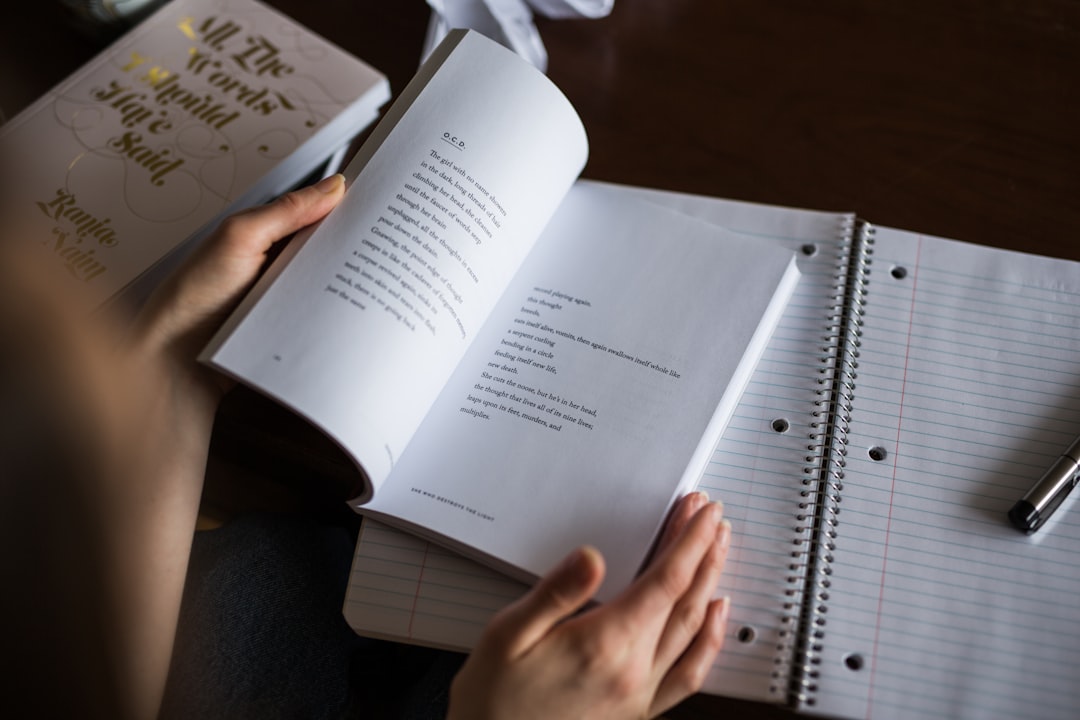
Photo by Thought Catalog on Unsplash
There's a moment in Ocean Vuong's "Night Sky with Exit Wounds" when you realize the most devastating line isn't actually there. You're reading about a mother and son, about violence and love tangled together, and suddenly the poem stops. What follows are white spaces, margins, the kind of emptiness that makes your chest tight. Vuong didn't fail to finish his thought. He finished it perfectly by refusing to finish it at all.
This is the secret that separates competent poets from the ones who burrow into your brain: the power of strategic silence.
Most people think of poetry as language. Words arranged with precision, rhythm, rhyme, the whole choreography of sound and meaning. But the poets whose work stays with you—the ones you find yourself thinking about weeks later while doing dishes—they understand something fundamental: what you leave out matters more than what you put in.
The Mathematics of Less
Emily Dickinson knew this in the 1800s, back when literary critics were still trying to "fix" her dashes and weird line breaks. She'd write something like: "Hope is the thing with feathers – / That perches in the soul –" and then she'd just stop. Not end the thought. Stop it. The dashes aren't punctuation mistakes. They're pauses. They're the reader's chance to breathe, to sit with the image, to complete the poem themselves.
Here's what makes this work psychologically: your brain abhors incompleteness. It's wired to fill in gaps. When Dickinson leaves you hanging, your mind doesn't just accept the silence—it races to fill it. You become a co-author. The poem becomes something between the page and your skull, and that collaboration makes it stick in ways a fully explained poem never could.
Consider the math: a 10-line poem with complete thoughts lands once. A 10-line poem with strategic gaps, with silence doing half the work? That lands differently in each reader. It becomes infinite. It becomes personal.
When Words Become Liars
There's a reason confessional poets—Sylvia Plath, Sharon Olds, the whole lineage of poets who excavate their own wounds—understood that sometimes the most honest thing is to stop talking.
Plath's "Mad Girl's Love Song" does something strange. It's only 16 lines, but it feels longer because of what's missing. She describes obsession, confusion, a girl who doesn't know what's real. And then: "I think I made you up inside my head." The poem ends. No resolution. No moral. No redemption arc. Just that one sentence sitting there like a confession you weren't supposed to overhear.
Words are tools for lying. We use them to shape reality, to defend ourselves, to construct narratives where we're the good guy. But silence? Silence is harder to fake. When a poet chooses not to explain something, when they let a moment dangle unresolved, it feels like truth because it doesn't have the propaganda of language attached to it.
This is why the volta moment—that crucial turn where the poem pivots to new meaning—works so effectively. The volta often relies on what's been unsaid, on the weight of everything the poet has held back before the shift.
The White Page as a Character
Poets like Anne Carson and Claudia Rankine have pushed this further. They use the page itself as part of the poem. Carson's "Autobiography of Red" includes fragments, footnotes, spaces that mean something. Rankine's work in "Citizen" uses blank space not as mistake but as presence—the empty room where racial violence happens, the silence that follows a micro-aggression.
This isn't avant-garde for avant-garde's sake. It's recognition that meaning lives in more than just letters.
When you read a Rankine poem and encounter a page that's mostly white space with a few sentences floating on it, you're not reading a poorly formatted document. You're reading visual silence. You're experiencing the isolation of the poem's subject as isolation on the actual page. Form becomes content becomes form.
Silence as Rebellion
There's something almost defiant about poets who choose silence. Everyone else is screaming. TikTok is screaming. Twitter is screaming. The 24-hour news cycle is screaming. To write a poem that pauses, that refuses to explain itself, that trusts the reader to handle ambiguity—that's an act of resistance.
It's also why poetry matters now more than it might ever have mattered. We're drowning in language. We're suffocating in information. A well-placed silence feels like air.
The poets working today who you'll remember—the ones whose collections you'll actually read instead of just buying for your coffee table—they're the ones who understand that poetry isn't about fitting as many words as possible into a limited space. It's about using every element on the page, including the emptiness, to create a moment of recognition.
The Reader's Responsibility
Here's what makes this frustrating and exhilarating: silent poetry demands something from you. It won't hold your hand. It won't package meaning into a neat message. It offers you a frame and asks you to look at what's inside, knowing that what you see might be different from what another reader sees.
That's not a bug. That's the entire point.
Next time you read a poem that seems to end abruptly, that leaves you with questions, that has more white space than words—don't assume the poet ran out of ideas. Assume they had the courage to run out of explanations. Assume the silence is intentional. And then sit with it. Let your own mind complete the picture. That's when poetry stops being something you read and becomes something you experience.
Comments (0)
No comments yet. Be the first to share your thoughts!
Sign in to join the conversation.