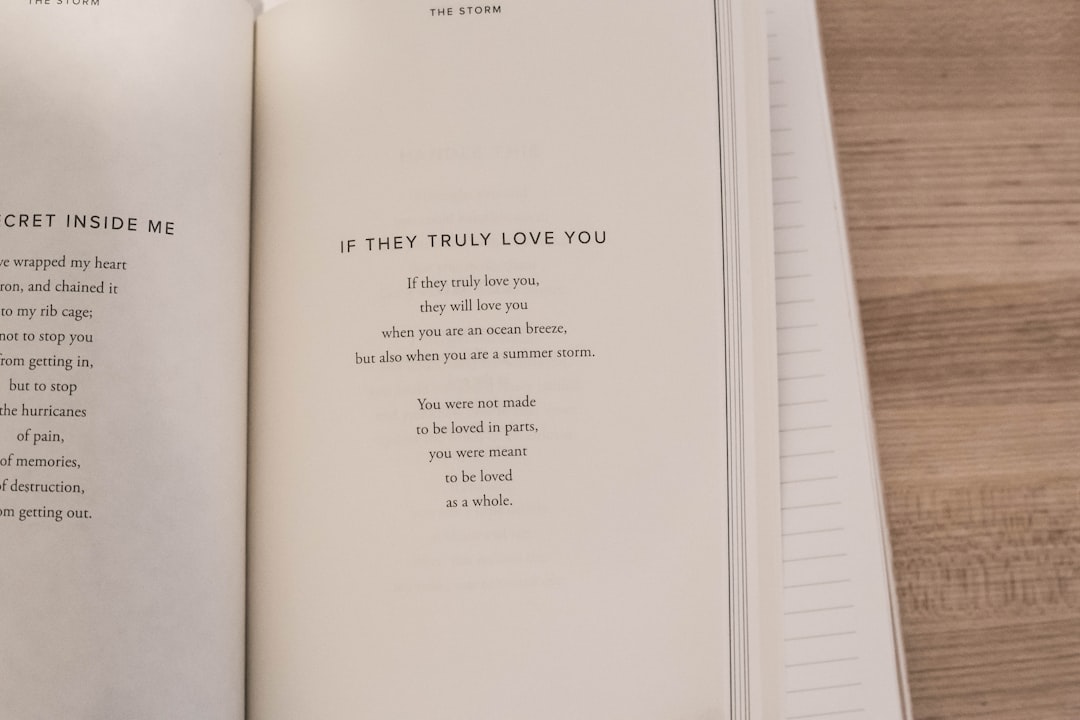
Photo by Thought Catalog on Unsplash
Most poets in the English-speaking world grew up believing there were only a handful of ways to write a poem. Sonnets. Free verse. Haikus. Maybe villanelles if they were feeling ambitious. But then, somewhere around the 1960s, American and British poets stumbled upon a form that had been perfecting itself for fourteen centuries in the Middle East and South Asia—a form so liberating that it fundamentally challenged everything they thought they knew about poetic structure.
That form is the ghazal. And it might just be the most subversive poem you've never heard of.
What the Ghazal Actually Is (And Why Your English Teacher Never Mentioned It)
Let's start with the basics. A ghazal is a poetic form consisting of rhyming couplets and a refrain, written in monorhyme. Each individual couplet, called a "beyt," can stand entirely alone as a complete poem. It doesn't need context from the verses before or after it. This is the revolutionary part: you can read a ghazal in any order. Start at the beginning. Jump to the middle. Read it backwards. The meaning doesn't collapse.
The form originated in seventh-century Arabia and developed most fully in Persian, Urdu, and Arabic poetry over the centuries. Poets like Hafiz and Mir became legendary for their mastery of the form. But until the 1960s, ghazals were largely invisible to English-language poets—a blind spot that had everything to do with cultural dominance and everything to do with how Western poetry traditions had calcified into seemingly unchangeable rules.
The ghazal's formal properties are specific. The first couplet introduces the rhyme and refrain (called the "matla"). Subsequent couplets follow a pattern: the second line of each beyt contains the refrain, while the first line must contain a word or phrase that rhymes with the refrain. The poet's name often appears in the final couplet, a signature woven into the poem itself. But here's where it gets interesting: these requirements aren't chains. They're scaffolding that allows maximum freedom within their structure.
The American Discovery: When Poetry Met Radical Possibility
Agha Shahid Ali changed everything. The Kashmiri-American poet encountered the ghazal while studying at UC Berkeley in the 1960s and became obsessed. He didn't just translate ghazals from Urdu and Persian; he wrote them. In English. And he began teaching other American poets how to do it.
By the 1970s and 1980s, poets like John Hollander and Adrienne Rich were experimenting with the form. What they discovered was astonishing: the ghazal gave them permission to write poems that didn't have to "go" anywhere. They didn't require narrative arc or emotional climax. They didn't demand that you follow a logical progression of ideas. A ghazal could shift from the personal to the philosophical to the political within a single page, and that discontinuity wasn't a flaw—it was the entire point.
Consider how liberating this was for poets who felt constrained by the Western insistence on coherence and resolution. The ghazal said: Your thoughts don't have to connect like plot points. Your heart doesn't have to follow a linear path. You can contradict yourself. You can fragment. You can leap.
Why the Ghazal Matters to Modern Poets (And Why You Should Care)
There's something about contemporary life that makes the ghazal feel urgently necessary. We live in an age of infinite scroll, of fragmented attention, of thoughts that arrive disconnected and contradictory. The ghazal doesn't ask us to impose a false unity on experience. Instead, it mirrors how consciousness actually works: in sudden associations, recurring obsessions, unexpected juxtapositions.
Poets have used the ghazal to write about displacement, diaspora, grief, and resistance. Pakistani-American poet Kazim Ali uses the form to explore queer identity and exile. Palestinian poet Mahmoud Darwish wrote political ghazals that refused to simplify struggle into rhetoric. The form becomes a tool for poets whose experiences don't fit neatly into conventional Western structures—which is to say, most of us, most of the time.
But the ghazal's power extends beyond what it represents. It's how the form actually functions as a reading and writing experience. When you read a ghazal, you're not waiting to be brought somewhere. You're not climbing toward a conclusion. Instead, you're moving through a series of luminous moments, each complete in itself. The repetition of the refrain creates an incantatory quality—hypnotic, almost meditative. You feel the poem working on you differently than you're used to.
And when you write a ghazal? The formal constraints actually unlock freedom. The requirement to make each couplet standalone means you have to make every line count. No filler. No transition sentences that carry you from point A to point B. Just the essential music and meaning, distilled.
The Ghazal's Influence on Contemporary Poetry
Today, the ghazal isn't some exotic form gathering dust in academic textbooks. Young poets are writing them. Slam poets are performing them. The form keeps evolving as it moves through different languages and cultures and communities—which, ironically, is exactly what it's been doing for fourteen hundred years.
If you're interested in understanding how poetic forms can be revolutionary—how the structure you choose determines not just how something sounds but what it's actually capable of saying—the ghazal is essential. It challenges the assumption that "good" poetry must follow Western templates. It proves that constraint and freedom aren't opposites; they're collaborators.
And if you've ever felt like your own experience didn't fit the narrative arc demanded by conventional poetry—if you've ever sensed that human consciousness works in mysterious recursions rather than straight lines—the ghazal has been waiting for you. It's been waiting for fourteen centuries, actually, patient and insistent, ready to teach us all that there are more ways to say things than we ever imagined.
The ghazal asks us to reconsider what poetry can be. It reminds us that freedom isn't the absence of form; it's the discovery of forms that finally let us speak in our own voices. And in a world that constantly demands we simplify, resolve, and arrive at easy conclusions, that radical act of fragmentation feels less like a technical choice and more like necessary rebellion.
For poets looking to understand how structural choices shape meaning—and how inherited forms can be transformed through cross-cultural exchange—we recommend exploring The Volta Moment: Why Poetry's Most Powerful Tool Isn't a Technique—It's a Turning Point, which examines how poems achieve their most transformative moments.
Comments (0)
No comments yet. Be the first to share your thoughts!
Sign in to join the conversation.