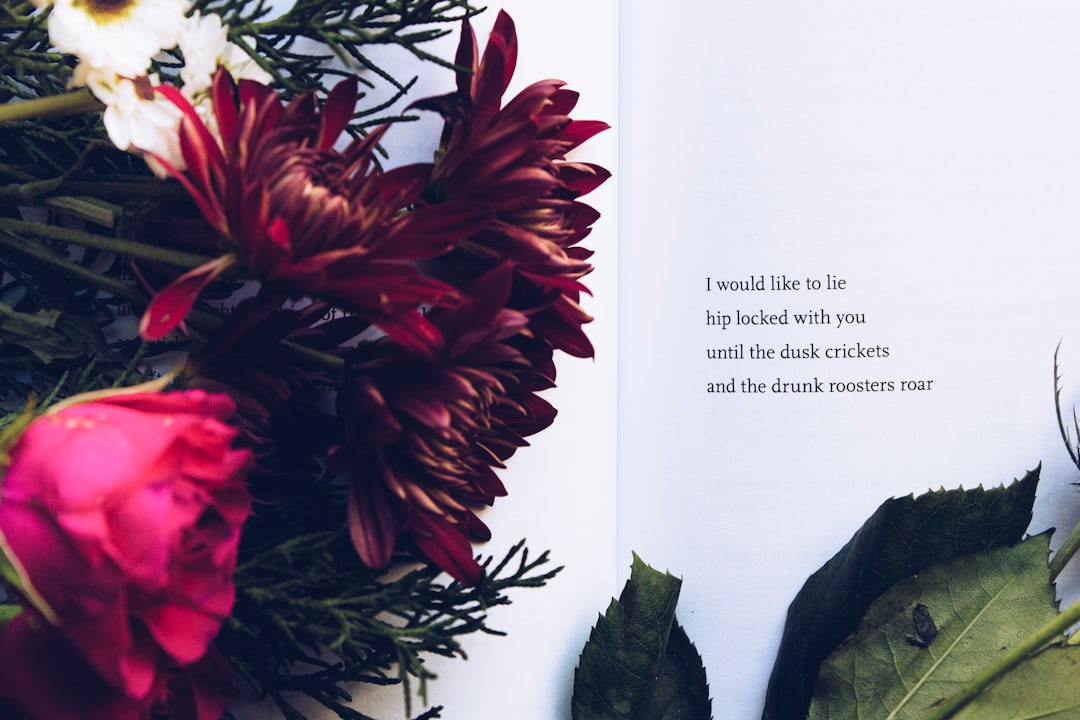
Photo by Thought Catalog on Unsplash
When a Line Break Changes Everything
Mary Oliver wrote: "You do not have to be good." Then she broke the line. "You do not have to walk on your knees / for a hundred miles through the desert repenting." That enjambment—that deliberate spillover from one line to the next—transforms a simple statement into something that feels like permission itself, like breath returning to lungs.
Most readers skip over line breaks without thinking. We're trained to see them as typographical quirks, technical necessities forced by page width. But enjambment isn't a formatting accident. It's a deliberate choice that poets use to manipulate time, create surprise, and force us to experience language differently than we would in prose.
An enjambment occurs when a grammatical phrase or clause runs over the line break without punctuation. The reader expects completion at the line's end but finds only suspension. We're left hanging, forced to move into the next line seeking resolution. This simple device—this pause and push—has become one of poetry's most electrifying techniques.
The Mechanics of Suspense
Here's what makes enjambment work so viscerally: it mimics the rhythm of uncertainty. When T.S. Eliot wrote "Let us go then, you and I, / When the evening is spread out against the sky / Like a patient etherized upon a table," he wasn't just breaking lines for aesthetic reasons. He was slowing us down, forcing us to sit in that image longer than we would in normal speech.
Consider the difference between these two versions of a hypothetical line:
Version A (no enjambment): "The dog leaped over the fence and disappeared into the woods."
Version B (enjambment): "The dog leaped over / the fence and disappeared into / the woods."
In version B, we experience the jump differently. We leap with the dog. We pause at that fence. We feel the moment of disappearance as it happens, not after it's already complete. Time stretches. Tension builds.
Modern poets understand this intuitively. Ocean Vuong's collection "Night Sky with Exit Wounds" is practically built on enjambment. Nearly every poem in that book uses line breaks to create what poet Claudia Rankine calls "the muscle of meaning." Words get new neighbors. Sentences get interrupted. And suddenly a casual observation becomes something loaded with weight.
The Meaning-Making Game
But here's where enjambment gets really clever: it can completely alter a poem's meaning through strategic line breaks. This is where poets become magicians.
When Lucille Clifton wrote "she understands / the nature of struggle," the break isolates "understands" on its own line before we know what exactly is being understood. Grammatically, the sentence needs completion. Emotionally, that pause creates weight. We might briefly wonder if she merely understands—as in, she's aware—before the next line reveals it's understanding of something specific, something difficult.
Rupi Kaur uses enjambment relentlessly in her Instagram-famous poetry. While critics debate her literary merit, they can't deny her understanding of the device. Lines like "i am my / mother's daughter / my father's strength" use breaks not for complexity but for emphasis, turning each fragment into a separate revelation.
This technique allows poets to do something prose can't: create genuine ambiguity and multiple readings from a single text. The same words read differently depending on whether we pause or push forward. The volta that changed everything in poetry often works hand-in-hand with strategic enjambment, creating moments where the poem's meaning literally shifts before our eyes.
Why Enjambment Matters Right Now
Contemporary poets are pushing enjambment to extremes. Some break lines so aggressively that pronouns separate from their verbs. Others use it to create visual patterns on the page—words scattered like thoughts, forcing us to construct meaning from fragments.
This matters because we live in an age of quick scrolling and skimming. Poetry has always offered resistance to passive reading, but enjambment makes that resistance physical. It forces your eye to move in a specific way. It controls your pace. You cannot rush through a well-enjambed poem.
In 2023, the Academy of American Poets reported that poetry reading increased by 47% among readers aged 18-34, with most citing Instagram poets and TikTok poetry accounts as their entry point. These younger readers might not know the term "enjambment," but they're responding to its effects. They feel the pause. They sense the power.
Poets like Amanda Gorman, whose "The Hill We Climb" was read at the presidential inauguration, use enjambment strategically to create rhythmic propulsion. The poem practically tumbles forward, with line breaks controlling exactly where we catch our breath. That wasn't accidental. It was architectural.
The Future of the Line Break
As poetry moves increasingly into digital spaces, the line break becomes even more crucial. On a screen, where we control scrolling and spacing, poets have even more power to manipulate our experience of their words. Some experimental poets now use HTML and CSS to create enjambments across web pages—the poem literally continues off-screen, forcing you to scroll to complete a thought.
What makes enjambment endure is simple: it works on us emotionally before we understand it technically. A well-placed line break feels right before we can explain why. It creates suspense without a plot. It builds meaning through absence, through the space between words.
So the next time you read a poem and notice your eyes halting unexpectedly at the end of a line, pay attention. That's not an accident. That's a poet controlling your breath, your pace, your experience of language itself. That's enjambment doing what it does best: making the written word feel urgent, alive, and impossible to ignore.
Comments (0)
No comments yet. Be the first to share your thoughts!
Sign in to join the conversation.