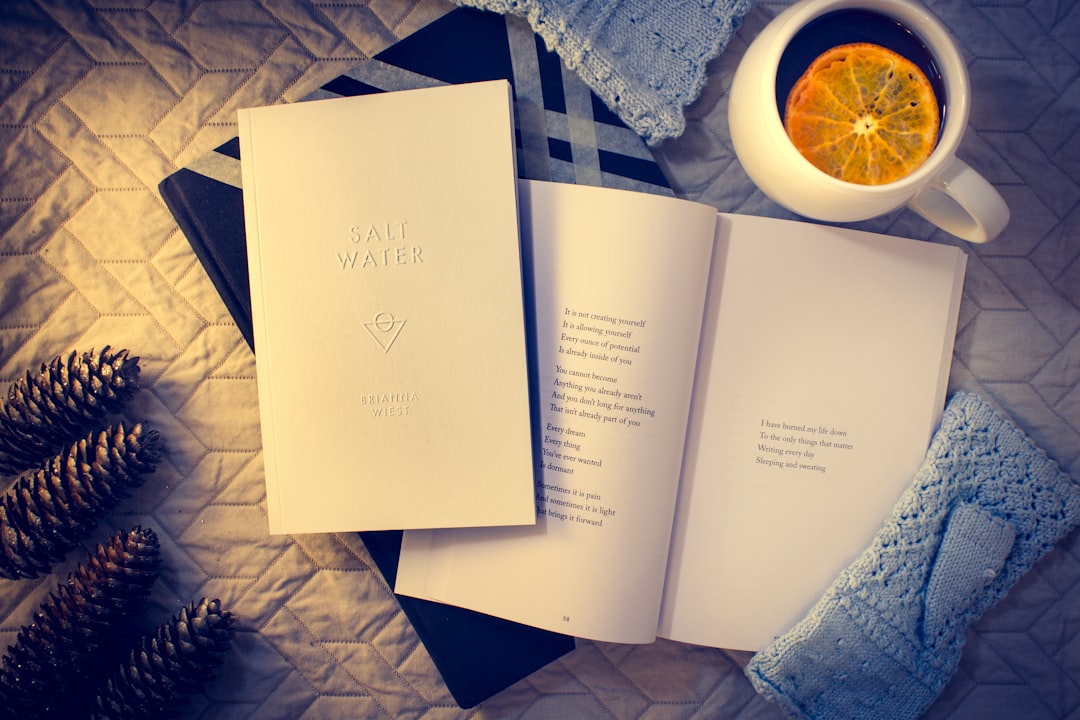
Photo by Thought Catalog on Unsplash
Most people learn about enjambment in high school and immediately forget it. It sounds technical, clinical even—the kind of term that makes poetry feel like a puzzle box instead of something alive. But here's the thing: enjambment might be the most viscerally human technique in all of poetry.
An enjambment occurs when a sentence or phrase carries over from one line to the next without a terminal punctuation mark. That's the clinical definition. But what it actually does is make your reader's body do something involuntary. Your eyes reach the end of a line expecting resolution, expecting a period, expecting to breathe. Instead, you're yanked forward into the next line. You're gasping. You're off-balance.
It's manipulative. It's brilliant. It's everywhere once you start looking for it.
When the Line Break Becomes a Weapon
Consider Sylvia Plath's "Mad Girl's Love Song." The poem opens with "I shut my eyes and all the world drops dead." Simple. Brutal. But look at how Plath uses enjambment throughout the piece—lines tumbling forward, refusing punctuation, making the reader complicit in the speaker's fractured mental state. You don't get to pause. You don't get to be comfortable. You're living inside her instability.
Or take Ocean Vuong's "Night Sky with Exit Wounds," a collection that weaponizes enjambment against narrative stability. Vuong breaks his lines in ways that create multiple possible meanings, depending on where your eye catches. A word left dangling at the line's end takes on new weight, new resonance, new intimacy. The form becomes inseparable from the content. You're not just reading about fragmentation—you're experiencing it.
What's wild is that enjambment has been around for centuries. But contemporary poets have turned it into something almost aggressive, something that forces readers to confront the gap between expectation and reality. Every time you reach a line break expecting punctuation and find none, you're experiencing a tiny moment of cognitive dissonance. And that moment? That's where poetry lives.
The Physics of Breath and Meaning
Here's something nobody tells you: enjambment changes how your body reads. A line break is a place where your eye naturally pauses, where your breath wants to rest. But enjambment denies you that rest. It forces your vocal cords, your lungs, your reading pace into alignment with the poet's intentions.
Research in reading studies shows that line breaks significantly impact processing speed and comprehension. Your brain reads differently when there's a visible break in the text. Enjambment hijacks that natural rhythm and creates tension between the visual structure (the line break) and the grammatical structure (the ongoing sentence). This tension is where the poem's real work happens.
Mary Oliver, who was masterful at this, used enjambment to create movement through her nature poems. In "The Journey," she breaks lines in ways that mirror walking, pausing, pushing forward. The form becomes the content. You're not just reading about a journey—your reading process becomes the journey.
Why Contemporary Poets Can't Stop Using It
Walk through any contemporary poetry collection, and enjambment is everywhere. Why? Because it's become the primary way poets express fragmentation, speed, and the overwhelming nature of modern consciousness. Look at someone like Claudia Rankine or Maggie Smith—their work relies heavily on enjambment to create moments where meaning bifurcates, where multiple interpretations exist simultaneously.
There's also something democratizing about it. You don't need fancy vocabulary or classical education to feel the effects of enjambment. Your body knows. Your breath knows. A reader with zero formal poetry training will still feel the tug, the push, the refusal to settle.
The poets doing the most interesting work right now understand something: in an age of infinite scroll, of constant interruption, of truncated attention spans, enjambment mirrors our actual experience of consciousness. We don't move smoothly through thought. We lurch. We pause. We're interrupted. We continue. Enjambment is the form that speaks our linguistic reality.
Learning to See It, Learning to Use It
If you're writing poetry, enjambment is a tool that demands intentionality. A careless line break is immediately obvious—it feels arbitrary, unmotivated. But a purposeful one? It's the difference between a poem that sits on the page and one that grabs you by the collar.
Start by noticing where your natural pauses want to happen. Where would punctuation normally go? Now deliberately break the line *before* that pause. Notice what happens to emphasis, to meaning, to the rhythm. A word isolated at the end of a line becomes weighted. A verb separated from its object creates suspense.
What makes enjambment so powerful is that it forces a conversation between the poet and the reader. The poet says: I'm breaking the line here. The reader feels it, adjusts, leans in. It's a form of trust and tension simultaneously. The reader has to actively participate in creating the poem's meaning, not just receive it passively.
The Permission It Gives
Maybe the most important thing about enjambment is what it signals: that line breaks matter, that white space matters, that the *shape* of words on the page isn't decorative—it's essential. If you want to understand how contemporary poets think about form, enjambment is the master class.
It's also given permission to poets who might not naturally think in traditional meters or rhyme schemes. Enjambment is how free verse creates structure without those scaffolds. It's how meaning gets built when you're working without a net.
For more on how poets create turning moments that shift everything, consider how the volta works in tandem with strategic line breaks. Both are about creating the conditions for transformation—one in meaning, one in breath.
The next time you read a poem and feel that peculiar moment of being pulled forward, of expectation denied, of having to chase meaning across a line break—that's enjambment working. That's a poet saying: slow down, pay attention, your body is part of this poem now. And that's when poetry stops being words on a page and becomes something that actually moves you.
Comments (0)
No comments yet. Be the first to share your thoughts!
Sign in to join the conversation.