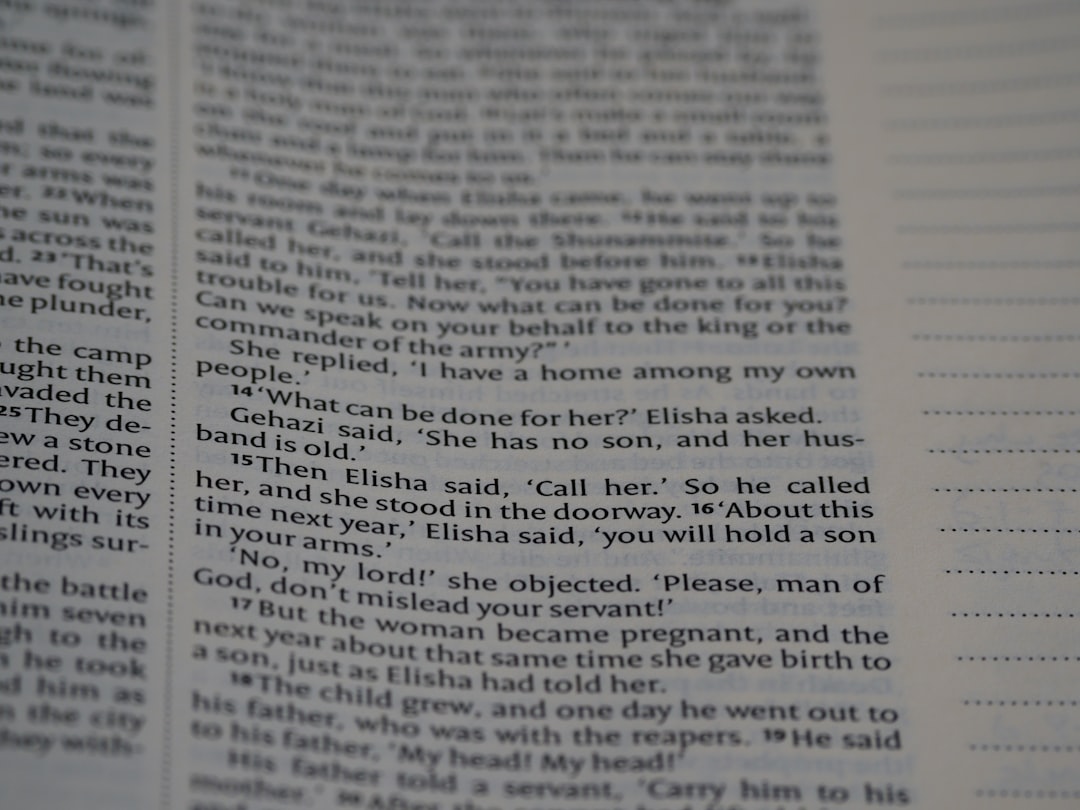
Photo by Brett Jordan on Unsplash
Margaret Chen had spent exactly 42 years at Riverside Public Library. Forty-two years of date stamps, overdue notices, and the satisfying click of the book scanner. She could recite the Dewey Decimal System backward. She'd reorganized the entire mystery section three times. And she'd never found a single reason to leave.
On her last Tuesday before retirement, as she methodically cleared her desk, Margaret pulled a cart of recently returned books toward the back room. The stack felt heavier than usual—or maybe that was just the weight of 1,528 days at a single circulation desk finally settling into her bones. She was 68 now. Silver streaked her black hair. Her knees complained when she climbed the tall ladder to the top shelves.
The book caught her eye purely by accident. It was a 1983 edition of "The Remains of the Day" by Kazuo Ishiguro, the spine cracked exactly halfway through, suggesting someone had read it carefully—or obsessively. Margaret had catalogued this particular copy at least five times over the decades. It always came back. It always left again.
The Forgotten Artifact
As Margaret prepared the book for reshelving, something fell from between pages 147 and 148. A bookmark. Not the plain library bookmark everyone received, but something handmade. Cream-colored cardstock, folded carefully in half, with elegant cursive writing on both sides.
Margaret's hands trembled as she unfolded it.
On one side: "To James, my forever reader. May you find the ending you deserve. —M"
On the other: A series of numbers. A date: "June 15, 1983." And coordinates. Actual latitude and longitude.
She sank into the rolling chair beside the return cart. The bookmark felt impossibly delicate. The ink had faded to a pale blue-black, barely visible in certain light. Someone had written this with care. Someone had written this as a goodbye.
Margaret knew every regular patron who had ever checked out this book. She'd built an entire career on remembering such details. Yet she had no memory of anyone named James. More curious still—why would someone tuck a handmade bookmark into a library book and leave it for strangers to find? For decades, no less?
The Investigation Begins
The coordinates led to a place 47 miles north of the city: Blackwood State Park. Margaret checked the library's records, something she'd technically stopped having authorization to do the moment she signed the retirement paperwork that afternoon. The 1983 checkout card for this edition was gone. The microfiche was archived in boxes Margaret wasn't supposed to access anymore.
She accessed them anyway.
The last person to check out "The Remains of the Day" on June 14, 1983, had signed their name as "J. Morrison." The address listed was a postal box. No phone number on file. No other books checked out that year. It was as if this James Morrison had materialized once, borrowed a single novel, and vanished from the system entirely.
Margaret printed out a map before she left work that day. She told herself it was just curiosity. Librarians are curious people by nature—it's practically in the job description. We spend our lives surrounded by mysteries, by stories whose endings readers never tell us.
That Friday morning, Margaret drove north with the bookmark on her dashboard and her retired library card in her purse. She wasn't sure what she expected to find. A cabin? A cemetery? A message carved into a tree? The coordinates were frustratingly specific—latitude 42.847, longitude -71.629—yet the state park sprawled across 8,000 acres of protected forest.
What Margaret found was a clearing.
The Message in the Clearing
The clearing itself was unremarkable: a natural break in the oak and pine trees, the forest floor soft with decades of needles and fallen leaves. A stream ran nearby, its sound muffled in the summer heat. And there, near what might have been a marked hiking trail, stood a bench. A proper memorial bench, weathered to silvery gray, with a bronze plaque.
Margaret approached slowly. Her sneakers crunched on gravel.
The plaque read: "In loving memory of James Morrison, 1962-1983. Reader. Dreamer. Forever young."
Margaret sat down on that bench—carefully, as if it might disappear if she moved too quickly—and finally allowed herself to cry. She cried for a young man she'd never met. She cried for the mysterious "M" who had loved him enough to mark the spot with coordinates hidden in a library book, betting that someday, someone would find it. Someone would follow the breadcrumbs. Someone would know that James Morrison had mattered.
And she cried because she suddenly understood something about her forty-two years at the circulation desk. She hadn't just been scanning books and processing returns. She'd been holding the threads that connected strangers to stories. She'd been the keeper of secret bookmarks and forgotten messages. Every library is haunted by the ghosts of its readers—by the people who borrowed books and changed, by the stories that changed them, by the love left in margins and between pages.
The Final Chapter
Margaret never identified who "M" was. She tried—Lord knows she tried, digging through old reference materials and calling the park's administrative office. But some stories, she realized, were meant to remain incomplete.
What she did instead was revolutionary, at least by her standards. She created a section in the library called "Notes Between Pages"—a carefully maintained collection of donated books with handwritten messages, bookmarks, and letters left inside. Patrons could read the discovered words. Some left their own. A teenager named Marcus left a note: "Mom, when you find this, I'm gay and I'm happy. I hope you will be too." An elderly widower left a poem: "For my Helen, who loved mysteries. I'm solving the greatest one now."
Margaret returned to that clearing four times a year until she could no longer make the drive. She left fresh flowers, even though the plaque never acknowledged her presence. She believed that love—real, fierce love—doesn't need recognition. It just needs to be remembered. It needs someone to find the bookmark and understand that it mattered.
Near the end of her actual life, eight years after retirement, Margaret donated her entire personal collection to the library. Thousands of books. Thousands of stories. She included one final note in the box: "To whoever finds the bookmark I left in 'The Remains of the Day'—thank you for understanding that some stories don't have endings. They have legacies."
If you're interested in how libraries preserve the stories hidden within stories, read about the photograph that changed everything when discovered in an unexpected place.
Comments (0)
No comments yet. Be the first to share your thoughts!
Sign in to join the conversation.