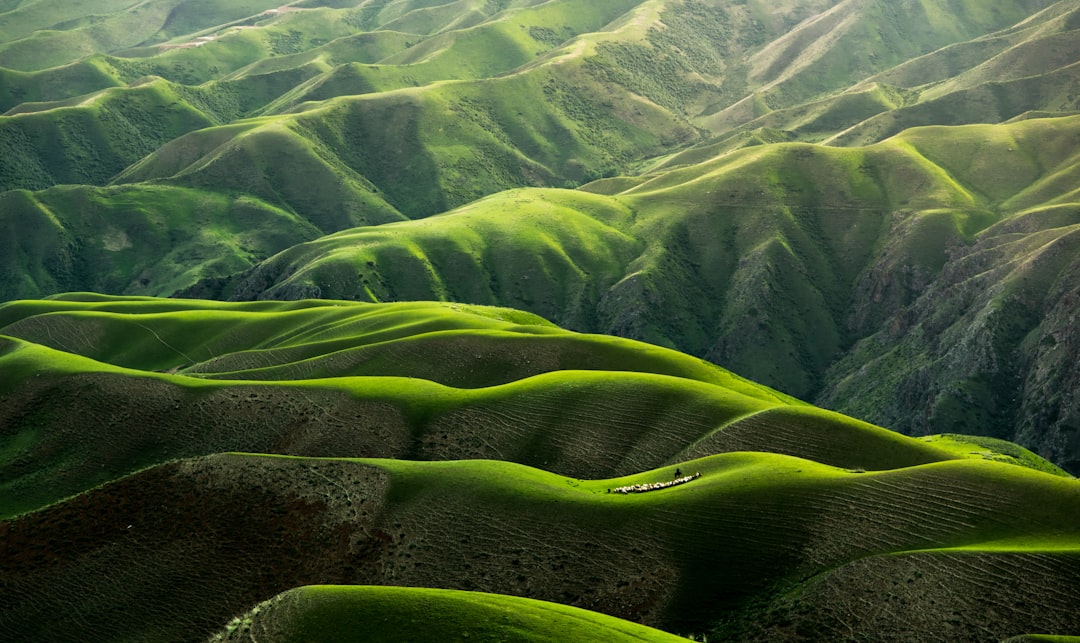
Photo by Qingbao Meng on Unsplash
Sarah Chen spent three years watching her suburban quarter-acre transform into something she never expected: a hotspot for native bee species. When she stopped mowing every corner of her yard and let sections grow wild, when she planted milkweed and black-eyed Susans instead of ornamental imports, something shifted. Within months, monarch butterflies showed up. Then came the songbirds. By year two, she'd counted species she'd never seen in her neighborhood before.
She wasn't trying to save the planet. She was just bored with maintaining a lawn.
But here's what matters: Sarah's backyard is part of something much larger than one woman's gardening rebellion. Across North America, Europe, and Asia, tens of thousands of private landowners are unknowingly creating what conservation scientists call "habitat corridors"—connected patches of native vegetation that allow wildlife to move safely through cities and suburbs. These corridors are becoming crucial as climate change forces animals to shift their ranges and as traditional conservation efforts struggle to keep pace.
The Corridor That Connects Your Neighbor's Yard to the Forest
Here's a fact that might surprise you: private landowners control roughly 60% of the land in the United States. Not governments. Not conservation organizations. You, your neighbors, and millions of other homeowners. That's more territory than all the national parks, state forests, and protected lands combined.
Dr. Elena Rodriguez, an ecologist at UC Davis, started researching residential gardens almost by accident. She was studying monarch butterfly populations in California's Central Valley and kept noticing that the insects were using suburban areas to migrate between protected regions. "We were finding monarchs in people's yards, using milkweed they'd planted," she explained in a 2023 interview. "We realized we needed to understand if these private spaces actually mattered for conservation."
The answer stunned her research team. When residential properties were managed with native plants and minimal pesticide use, they functioned almost identically to semi-natural habitats. A single well-planted yard didn't mean much. But when multiple yards on the same street, in the same neighborhood, followed similar practices, they created something genuinely significant.
Rodriguez's team mapped these informal corridors in three suburban regions. The results were striking: neighborhoods with 40% or higher adoption of native plantings showed biodiversity levels comparable to nearby protected nature reserves. "We weren't expecting that," she told me via email. "The data suggested that suburban habitat mattered. A lot."
What Changes When You Stop Fighting Nature
The mechanics are simple but profound. Native plants evolved alongside native insects and animals in specific regions. An oak tree in Pennsylvania supports over 500 species of insects, most of which are native to that tree. A imported ornamental Japanese maple? Maybe 15 species, and most of them aren't what local birds and insects need to eat.
When you plant native, you're not just adding decoration. You're rebuilding the food webs that sustain wildlife. Caterpillars need specific plants to eat. Birds need caterpillars. Insects pollinate flowers. Everything connects.
The pesticide piece matters equally. A single application of common insecticides can reduce insect populations by up to 75% within days. But insects aren't pests that deserve eradication—they're the foundational layer of every ecosystem. Without them, everything above collapses.
Consider what happened in a small neighborhood in Toronto when residents coordinated a shift to native plantings. A local naturalist, Paul, had been tracking bird populations for fifteen years. "For most of that time, we'd see the same species," he noted. "Robins, starlings, house sparrows. Then in 2019, neighbors started planting milkweed and native shrubs, removing their pesticides."
Within two years, Paul documented seventeen bird species he'd never seen in the neighborhood before. Scarlet tanagers. Cedar waxwings. Indigo buntings. "These birds were passing through but never stopping because there was nothing for them here," he explained. "Once there was food, suddenly the neighborhood became a rest stop on their migration route."
The Economics of Doing Nothing Differently
You might expect this requires extensive effort and expense. Sometimes it does. But often, it simply requires doing less—and that's actually cheaper.
A typical suburban homeowner spends between $200 and $500 annually on lawn maintenance and landscaping. Converting even half a yard to native plantings might run $300-$800 upfront, but annual maintenance drops dramatically. Native plants, once established, require minimal watering, fertilizing, or trimming. Some homeowners report cutting their landscape maintenance costs by 60% within three years.
Environmental benefits aside, this is a financial argument that works even for people who've never thought about climate change or biodiversity. Spend money once, save money forever.
Several municipalities have started catching on. Some now offer rebates for native plantings. Austin, Texas offers up to $8,000 in rebates for removing invasive species and replanting native vegetation. Other cities provide free native plants to residents who commit to specific habitat improvements. Vancouver has trained thousands of homeowners to transform their yards as part of a citywide ecological restoration program.
The Friction Between Beauty and Biology
Let's acknowledge the obvious: a messy yard with areas left unmowed, with dead wood piles and decomposing leaves, doesn't match most people's aesthetic expectations. Neighborhood associations have fined homeowners for letting grass grow tall or leaving dead trees standing (which, ironically, are crucial habitat for woodpeckers and other wildlife).
This is where the real barrier lies. Not science. Not cost. But culture.
Some neighborhoods are breaking through this. A community in Portland, Oregon created a "native plant district" where residents agreed to let their yards be more naturalistic. They installed small interpretive signs explaining what plants do what and why the yard looked the way it did. Within a year, the aesthetic perception shifted. People stopped seeing "neglected yards" and started seeing "pollinator gardens" and "wildlife habitat."
The same rebellion is spreading through Gen Z gardeners, many of whom seem genuinely uninterested in perfect lawns. TikTok is filled with videos of people celebrating their messy gardens, their volunteer plants, their insect populations. These young gardeners are prioritizing ecosystem function over appearance, and they're making it look intentional rather than lazy.
What Actually Matters Right Now
The Amazon rainforest matters. Wetland preservation matters. Protected wilderness matters. These statements are entirely true.
But so does your yard. So does your neighbor's yard. So does the collective decision of millions of homeowners to plant native species, reduce pesticide use, and tolerate a little beautiful disorder in their landscapes.
If you're concerned about pollinators, about bird populations, about insects—and you should be, because insects are declining precipitously worldwide—you don't need to wait for policy changes or donate to distant conservation organizations. You need to look at the patch of earth you control.
Start small. Plant one native species this season. Stop using pesticides on your property. Let one section grow tall. Then notice what shows up.
Sarah Chen's monarchs didn't arrive because she was saving the world. They arrived because she stopped managing her yard and let ecological relationships rebuild. That's not a metaphor for how environmental change works. That's often literally how it works.
The wildlife corridor doesn't exist because some distant agency declared it. It exists because millions of individual decisions, made by ordinary people in ordinary yards, created pathways where none existed before.
For more on how human spaces can restore ecosystems, check out our piece on Ghost Fishing: The Abandoned Nets Killing Oceans Silently, which explores how human infrastructure impacts wildlife in unexpected ways.
Comments (0)
No comments yet. Be the first to share your thoughts!
Sign in to join the conversation.