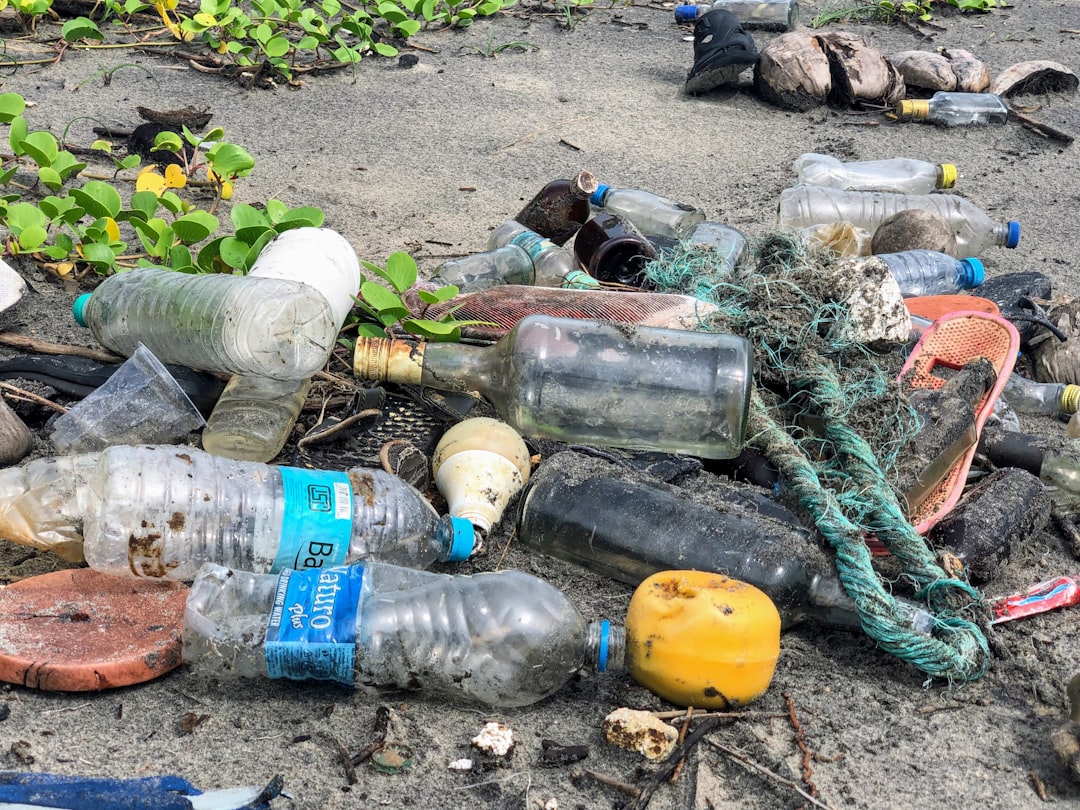
Photo by John Cameron on Unsplash
Last summer, a research team at the University of Bayreuth made a discovery that should have alarmed everyone. They found microplastics embedded in the testes of fish from the Danube River. Not just on them—inside them, integrated into reproductive tissue. When they ran the same test on male mice exposed to microplastics, the results were identical. The implications hit like a punch: we're not just polluting our water and air. We're rewriting the instruction manual of life itself.
This is what keeps some environmental scientists awake at night. Not the dramatic die-offs or the burning forests—those at least get attention. It's this slow, invisible infiltration happening in every organism from Antarctic penguins to the plankton at the bottom of the ocean food chain. Microplastics are smaller than the width of a human hair, invisible to the naked eye, and virtually everywhere. And we're only starting to understand how they work.
How We Created an Invisible Invader
Let's be honest: this didn't happen by accident. We made this mess intentionally, just without understanding the consequences.
Every plastic product you've ever used—from your toothbrush to your phone case to the fleece jacket you wore yesterday—sheds particles constantly. That jacket? A single wash releases approximately 124,000 microfibers into the water system. Multiply that by the millions of people washing synthetic clothing every single day, and you start to comprehend the scale of the problem. Then add tire wear from cars, degrading plastic bags, synthetic cosmetics, and the breakdown of larger plastic debris exposed to sunlight, and you've got a system that's essentially creating an endless stream of plastic particles that will outlive your great-grandchildren.
The EPA estimates that the average American unknowingly consumes 39,000 to 52,000 microplastic particles per year. If you drink bottled water instead of tap water, that number roughly doubles. Seafood eaters? They're ingesting thousands more. These particles are so small and so pervasive that they've become as normal to modern life as oxygen.
But here's where it gets genuinely disturbing: we have almost no idea what they're actually doing.
The Cellular Invasion Nobody Was Prepared For
For years, scientists assumed microplastics would simply pass through the body without consequence—too big to cross the blood-brain barrier, too inert to cause damage. They were wrong on both counts.
Recent research published in the journal Environmental Health Perspectives revealed that certain types of microplastics can actually penetrate cell membranes. They don't just sit in your digestive tract; they cross into your bloodstream. From there, they travel. To your organs. Your brain. Your unborn children, crossing the placental barrier. One 2024 study found microplastics in human blood for the first time, and the particles were present in 77% of all blood samples tested.
What happens once they're there? The honest answer is we don't know yet, because we've only started looking. But the preliminary findings are concerning enough to demand our attention. When researchers exposed fish larvae to microplastics, their neural development was disrupted. The larvae developed smaller brains and showed abnormal behavior patterns. They couldn't hunt effectively. They couldn't escape predators. In essence, the plastic was rewiring how their brains formed during critical developmental windows.
In mammals, microplastics have been shown to trigger inflammatory responses and oxidative stress in cells. Translation: your body recognizes them as foreign invaders and mounts an immune response, creating a state of low-level chronic inflammation. This is the kind of thing that doesn't kill you quickly. It just slowly damages your systems over decades.
The Evolutionary Roulette We're Playing
Here's what should genuinely frighten us: we're not just harming individual organisms. We're altering the genetic future of entire species.
When microplastics damage reproductive tissues—as the Bayreuth study showed—they don't just affect one fish. They affect its offspring's ability to reproduce, and their offspring after that. Evolution works on timescales of generations. We've been dumping microplastics into the environment in massive quantities for less than 70 years. But that's already long enough to see measurable changes in fertility rates across multiple species.
Oysters exposed to microplastics produce fewer eggs. Mussels show decreased spawning success. These aren't edge cases or laboratory artifacts—these are foundational species in marine food webs. When they start failing to reproduce at normal rates, the entire system destabilizes. And unlike the clear-cutting of a forest or a visible oil spill, nobody sees it happening. Nobody takes dramatic photos of infertile shellfish for social media.
Consider also what happens when animals migrate. Migratory birds cover thousands of miles every year, moving through ocean currents and atmospheric zones where microplastics accumulate. They ingest contaminated food. They inhale particles. They carry the pollution with them across entire continents, spreading it to breeding grounds and wintering areas that might otherwise have remained relatively clean.
What We Should Be Doing (And Mostly Aren't)
The obvious solution is to stop creating microplastics. Stop producing single-use plastics. Ban microbeads in cosmetics—which we've done in some countries but not others. Mandate synthetic clothing manufacturers include filters in washing machines. Regulate tire wear. These aren't theoretical ideas; countries like France have already banned certain microplastics, and washing machine manufacturers can install filters relatively cheaply.
But they won't, not at scale, because it requires regulation and corporate accountability. So instead, we fund research to understand the damage we're doing, publish papers about it, and continue manufacturing and consuming plastic at record rates.
The frustrating part? The science is already screaming at us. We have enough evidence to act. We're waiting for more evidence like a patient waiting for a diagnosis when the symptoms are already severe.
The Choice We're Making Right Now
Every microplastic particle in your body represents a choice someone made—a manufacturer choosing cheap materials over accountability, a consumer choosing convenience over consideration, a government choosing economic growth over precaution.
The particles themselves won't break down in your lifetime. They'll be there in 100 years. They'll be in the soil and the water systems for millennia. And we still don't fully understand the long-term consequences.
That's not a reason to panic. It's a reason to actually change something.
Comments (0)
No comments yet. Be the first to share your thoughts!
Sign in to join the conversation.