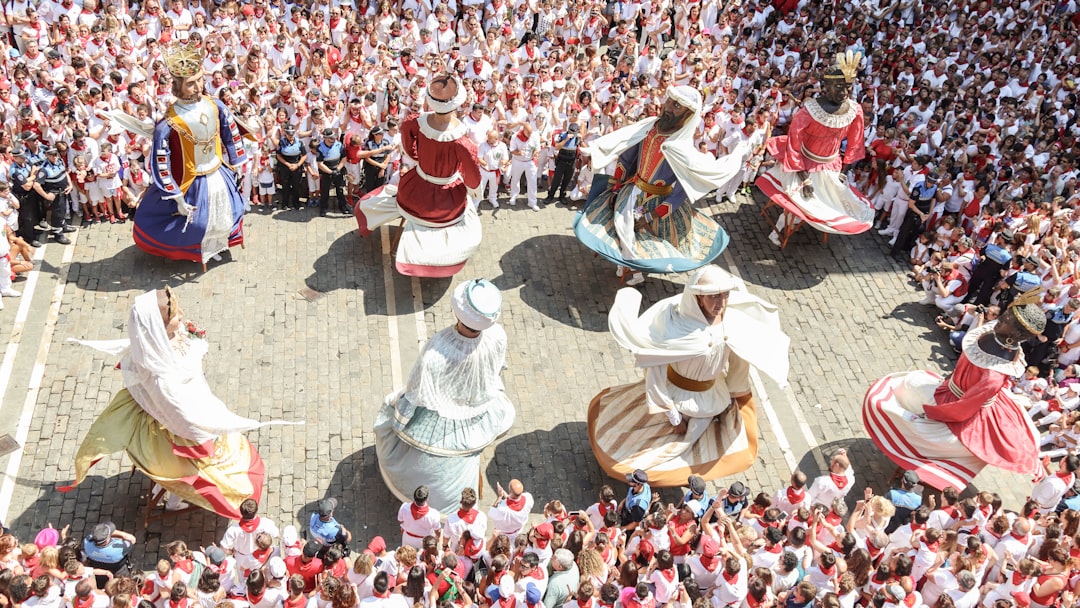
Photo by San Fermin Pamplona - Navarra on Unsplash
Joey Chestnut stands at the Nathan's Famous Fourth of July International Hot Dog Eating Contest, eyes locked on his competitor. The year is 2021, and he's about to stuff his sixteenth consecutive hot dog—plus bun—into his mouth in under ten minutes. The crowd roars. A documentary crew captures every agonized expression. This isn't a hidden fetish video uploaded to the dark corners of the internet. It's prime ESPN content, broadcast to millions. Somehow, competitive eating has become mainstream entertainment.
When did watching someone eat copious amounts of food become a legitimate sport? More importantly, why can't we stop watching?
From Sideshow Act to Serious Sport
Competitive eating isn't new. Medieval kings held eating contests. Renaissance fairs featured them. But modern competitive eating as we know it traces back to Nathan's Famous hot dog stand in Brooklyn, New York. What started in 1916 as a neighborhood celebration spiraled into an annual Fourth of July tradition. By the 1970s, it was a legitimate event. Today, it's a televised spectacle with sponsorships, training regimens, and celebrity participants.
The numbers are staggering. In 2023, Joey Chestnut consumed 76 hot dogs and buns in ten minutes. Seventy-six. That's roughly 20,000 calories in 600 seconds. Most people eat that many calories in two weeks. Yet there he was, sweating under stadium lights, competitive eating's undisputed champion, defending his title like it was the Super Bowl.
The International Federation of Competitive Eating, founded in 2004, now sanction competitions across dozens of categories. Not just hot dogs. Wings. Pie. Dumplings. Jalapeños. There's a whole universe of eating competitions, each with its own champions, training philosophies, and fan bases. Some competitors earn six figures annually. Some have agents. Some have nutritionists. This is real professional infrastructure built around consuming food at inhuman speeds.
The Psychology of Spectacle
But here's the peculiar thing: watching someone eat quickly isn't inherently entertaining. So why does competitive eating command millions of viewers?
Part of it is the violation of social norms. We're taught from childhood that eating should be civilized, measured, controlled. Competitive eating is the antithesis of that. It's transgressive. Watching someone abandon all pretense of moderation while the crowd cheers creates a strange catharsis. It's like attending a socially acceptable outlet for behaviors we suppress.
There's also an element of athletic respect. These competitors train seriously. They develop techniques. Takeru Kobayashi, a legendary competitive eater, uses the "Solomon Method"—alternating bites with water to expand his stomach capacity. Joey Chestnut trains his jaw muscles like they're tournament equipment. They study their competition. They refine their craft. It's no different than watching an Olympic athlete, except the athlete in question is performing an act we all do multiple times daily.
The rise of eating content creators on TikTok and YouTube suggests there's something deeper happening. The "mukbang" phenomenon—where creators film themselves eating large quantities of food—has millions of devoted followers. Some people watch for entertainment. Others find it weirdly soothing, almost meditative. Researchers have noted parallels to ASMR content: the sounds, the repetition, the focus create a hypnotic effect.
Maybe we're drawn to competitive eating because it represents pure commitment. In a world obsessed with optimization and restraint, these competitors go all-in on a single, ridiculous goal. There's something almost admirable about the absurdity.
The Dark Side Nobody Talks About
But there's a cost to this spectacle. A serious, physical cost.
Competitive eaters suffer from legitimate health consequences. Some develop stretch marks across their stomachs. Others report acid reflux so severe they need constant medication. Several retired competitors have discussed the lasting damage to their digestive systems. One anonymous competitor claimed to gain 60 pounds during competition season, then lose it afterward through a combination of diet and what sounds like dangerous dehydration.
Takeru Kobayashi, perhaps the sport's most famous name, developed an auto-immune disease that forced him to withdraw from competitions. Was it caused by competitive eating? No definitive proof exists. But the correlation raised questions the sport's organizers haven't adequately addressed.
There's also the body image dimension. Competitive eating exists in this weird space between celebration and mockery. Society simultaneously praises athletic excellence and ridicules people for eating too much. The competitive eater occupies both spaces uncomfortably.
Why We'll Keep Watching
Despite these concerns, competitive eating continues growing. The Nathan's contest drew over 10 million viewers in 2023. New eating competitions launch regularly. Streaming platforms now dedicate content to eating challenges. This audience exists, and it isn't shrinking.
Part of this persistence comes from the genuine human need for spectacle and transgression. We need outlets that challenge social norms in contained, safe environments. We need to watch people do things we wouldn't do, things that test the boundaries of the possible.
For those fascinated by how culture forms around seemingly arbitrary pursuits, the phenomenon of people obsessing over food traditions reveals how eating itself has become central to cultural identity.
Competitive eating is bizarre, troubling, and completely modern. It's the logical endpoint of a culture that simultaneously celebrates extreme athletic achievement and extreme consumption. It probably shouldn't exist. Yet here we are, millions of us, pausing our Sunday to watch Joey Chestnut cram hot dogs past his tonsils. There's something deeply, weirdly honest about that.
Comments (0)
No comments yet. Be the first to share your thoughts!
Sign in to join the conversation.