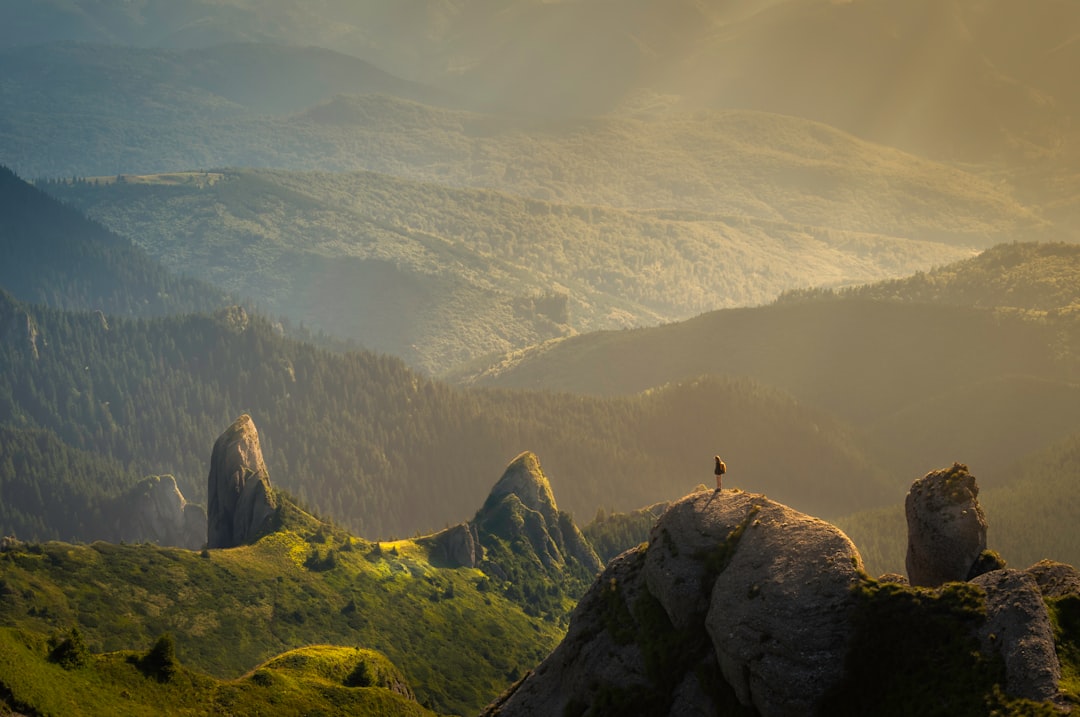
Photo by Urban Vintage on Unsplash
My alarm didn't go off on the Sofia-to-Bucharest train at 6 AM, but it didn't matter. I woke naturally as golden light flooded the compartment, casting long shadows across the green hills rolling past my window. A woman across from me was already on her second cup of Turkish coffee from a thermos, reading a newspaper in Cyrillic. The conductor hadn't rushed past in three hours. There were no overhead announcements. Just the steady rhythm of wheels on track and the occasional whistle.
This is the moment I realized I'd never want to fly across Europe again.
The Economics of Slow Travel Make Actual Sense
Here's something nobody tells you: train travel across Eastern Europe costs a fraction of what you'd pay for flights plus connections plus airport transfers. A sleeper train from Sofia to Bucharest runs about $45-60 for a bed in a six-berth compartment. A budget flight on the same route? Easily $80-120 once you factor in getting to the airport, parking or transport, and the airport hassle itself. And that's before considering how you'll actually get from the airport into the city center.
But the real economic argument isn't just about ticket prices. It's about what you're not paying for. You're not paying for a night's hotel because you're sleeping on the train. You're not paying for airport food because meals are included in sleeper fares, or at least available from the dining car. You're not paying for transportation from the airport because the train stations sit directly in city centers. The math works out to roughly one-third the total cost of flying.
I tracked my spending on a two-week Eastern European journey—six countries, five train journeys—and averaged $31 per day on transportation. My friend flying the same route? $267 per day, and that's before accommodation.
You Actually Meet People, Not Just Instagram Locations
The magic happens in the compartment. On my Budapest-to-Krakow overnight, I shared space with a retired Polish teacher, a Romanian software engineer traveling home for his mother's birthday, and a German woman writing a novel. We didn't exchange business cards or add each other on LinkedIn. We played cards until midnight, drank wine from plastic cups, and had the kind of conversation that only happens when you're trapped together for 12 hours with nowhere else to be.
The retired teacher told me about growing up during Ceaușescu's regime. The software engineer explained why tech companies are opening offices in Bucharest. The German writer asked me genuine questions about why I was traveling alone, not because she was networking, but because she was actually curious.
Compare this to a flight, where you're packed shoulder-to-shoulder with 180 strangers, nobody makes eye contact, and conversations die after "excuse me, you're blocking my armrest."
Train compartments are democratic spaces. You're all in the same boat—literally swaying together through the night. A surgeon sits next to a student. A grandmother shares her homemade pastries with a backpacker. Status markers dissolve when everyone's trying not to swing into the bunk above them at the same time.
The Scenery Isn't Fleeting—It's Your Constant Companion
When you fly from Budapest to Sofia, you see clouds. Maybe you see the Alps if you're lucky and the window seat works out. Then you're landing, and the experience is over.
On the train, you watch the landscape change. The Hungarian plains gradually give way to Serbian rolling hills. The Danube appears, disappears, reappears. You see villages where apparently nothing has changed since 1985. You pass through mountain passes where the track seems to be barely clinging to the cliff side. You notice when the architecture shifts, when the language on signs changes, when the light itself seems different.
This isn't just prettier—it's more human. You understand geography in your bones instead of your head. You stop thinking of countries as discrete rectangles on a map and start understanding them as connected, flowing, changing places.
I passed through valleys I'll never remember the names of, and I found myself staring out the window for hours without checking my phone once. Not because I had no signal (though that helped), but because the slow unfolding of the view was genuinely more engaging than anything in my pocket.
The Logistics Are Honestly Easier Than You Think
Before my first Eastern European train journey, I was convinced I'd need a special travel agent and a binder full of documents. Reality: Omio and Trainline cover 95% of routes, and you can book everything from your couch. Sleeper trains have websites with English versions. Conductors on major routes speak English. The reservation systems work.
Yes, some smaller routes require more planning. Yes, the ticket collectors on smaller regional trains might only speak Hungarian or Bulgarian. But this is actually a feature, not a bug. It forces you to slow down. It makes you present.
For a deeper dive into practical slow travel through this region, consider pairing train journeys with time on the ground—like exploring authentic local experiences once you arrive, which applies equally to Eastern European cities.
The Real Reason You Should Try This
The deepest reason to take trains across Eastern Europe instead of flying isn't about cost savings or meeting people or views. It's about what happens to your brain during those long hours of gentle motion.
You stop performing travel and start actually experiencing it. You can't Instagram a moment effectively when you're genuinely present. You can't work emails when the Wi-Fi cuts out and your phone battery is dying. You can't optimize or maximize or hustle when the train moves at its own pace regardless of your ambitions.
You're just... there. Watching the sun set over mountains. Listening to strangers' stories. Reading a book without guilt about your agenda. Existing in a European country without rushing to check everything off a list.
Three months after that Sofia-to-Bucharest train ride, I still think about that morning sun through the window. I still think about the woman with her Turkish coffee. I've already booked tickets for next summer.
Comments (0)
No comments yet. Be the first to share your thoughts!
Sign in to join the conversation.