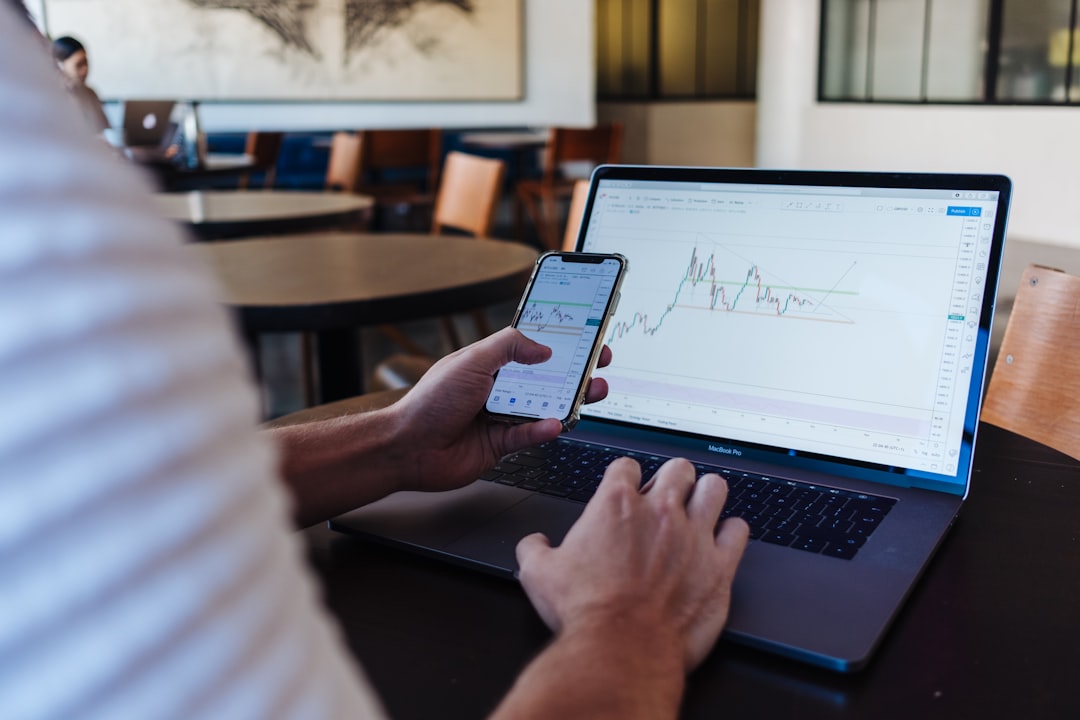
Photo by Jason Briscoe on Unsplash
Last Tuesday morning, Bitcoin price jumped $847 in exactly 3.2 seconds across three major exchanges. No news broke. No regulatory announcement. No celebrity tweet. Just money vanishing from retail traders' accounts and reappearing in the wallets of algorithmic trading operations.
Welcome to the hidden war inside crypto markets. While most people focus on price predictions and meme coins, a sophisticated ecosystem of AI-powered trading bots is quietly extracting wealth at a scale that would make Wall Street jealous. These aren't the flashy automated systems you hear about on Twitter. These are surgical instruments, operating with microsecond precision, exploiting inefficiencies that human traders will never even see.
The Math Behind the Machine
Arbitrage—buying an asset cheap in one place and selling it expensive in another—has always been crypto's dirty secret. On January 15th, 2024, Ethereum traded at $2,187 on Coinbase while simultaneously listed at $2,194 on Kraken. That $7 spread might sound trivial. Multiply it by 50,000 ETH moved through automated systems in a single hour, and suddenly you're looking at $350,000 extracted from the market.
The sophisticated operations don't stop there. Statistical arbitrage bots analyze thousands of trading pairs simultaneously, looking for correlations that break down for microseconds. When Bitcoin pumps, these systems instantly predict which altcoins will follow by analyzing historical patterns. They position themselves in advance, then exit as retail traders enter the market on the news.
The most aggressive players use what's called "sandwich trading." A bot spots your pending transaction in the mempool before it confirms. It jumps in front of you with its own transaction, moving the price. Your order executes at a worse price. Then the bot exits its position right behind you, pocketing the difference. On Ethereum alone, sandwich attacks siphon roughly $280 million annually from unsuspecting traders.
Why Speed Is Everything
Here's what most people don't understand: success in algorithmic trading isn't about being smart. It's about being fast. A bot operator in New Jersey with a direct line to Coinbase's servers has a 45-millisecond advantage over a trader in California. In that timeframe, they can spot a price discrepancy, execute a trade, and reverse their position. Forty-five milliseconds that translates to millions per year.
The industrial-scale operations invest in serious infrastructure. Some firms run servers in data centers physically co-located with exchange matching engines. Others hire networking engineers to optimize their connection latency down to the microsecond. One prominent operation allegedly paid $1.2 million annually just for premium fiber-optic connections to major exchanges.
This creates a two-tier market that most investors don't realize exists. There's the "market" you see on your phone with nice round numbers. Then there's the real market—a fractured ecosystem where prices differ by percentages across venues, and automated systems extract that value instantly.
The Pump-and-Dump Evolution
Old-school pump-and-dump schemes required coordination. You'd gather a Discord group, all buy together, push the price up, then dump on newcomers. Crude. Obvious. Illegal.
Modern bots have industrialized this concept while avoiding detection. They identify micro-cap tokens with low trading volume, then use coordinated orders across multiple accounts to create the illusion of activity. The "volume" appears real to casual observers—filled orders, executed trades, moving price action. But nothing real changed hands. It's a beautiful scam because there's technically no false information. Just sophisticated order placement.
Some operations run parallel strategies simultaneously. While one trading operation pushes token X upward, another posts fake buy orders for token Y, driving its price down. Then they sell their holdings in X and short token Y. The effect? They profit on both directions while making it look completely random.
The Arms Race and Its Casualties
There's an unspoken arms race happening right now. Firms spending millions on infrastructure advantages over competitors. It's not sustainable, but it's also not going away. The problem is that all this sophisticated technology, all this investment in speed and algorithms—it extracts value without creating any. Every dollar gained by a bot is a dollar lost to someone else.
And it's not equally distributed. If you're a retail trader checking prices on your phone, you're fundamentally outgunned. You can't see the orders that appear and disappear in microseconds. You can't execute trades faster than light-speed internet allows. You're playing a game designed so that you lose.
The regulatory response so far has been pathetic. The SEC talks about protecting retail investors while allowing these systems to operate with minimal oversight. Some exchanges have implemented measures like order size limits or rate-limiting to reduce bot activity, but workarounds exist. It's a technology arms race masquerading as market efficiency.
What Retail Traders Actually Need to Know
First: you're almost certainly losing to automation without realizing it. That slippage you notice? That's partly bot activity. That moment when you buy and the price immediately drops? Likely a bot exited right after you entered.
Second: longer timeframes reduce bot advantage. If you're trading on five-minute candles, you're competing directly with microsecond optimization. If you're analyzing weekly trends, you're at least in a different game.
Third: understand that market inefficiencies are being eliminated constantly. The spreads that existed two years ago are mostly gone now. Early crypto traders could stumble into arbitrage opportunities accidentally. Modern traders need actual edge—whether that's superior analysis, different risk tolerance, or yes, better technology.
Related to the broader issue of hidden market dysfunction, you should also understand why Bitcoin miners are secretly betting against Bitcoin—another example of how sophisticated players operate contrary to what retail investors assume.
The crypto market was supposed to democratize finance. Instead, it's created a more efficient extraction system than traditional markets ever achieved. The machines are winning. The only question is whether you're placing your bets against them or with them.
Comments (0)
No comments yet. Be the first to share your thoughts!
Sign in to join the conversation.