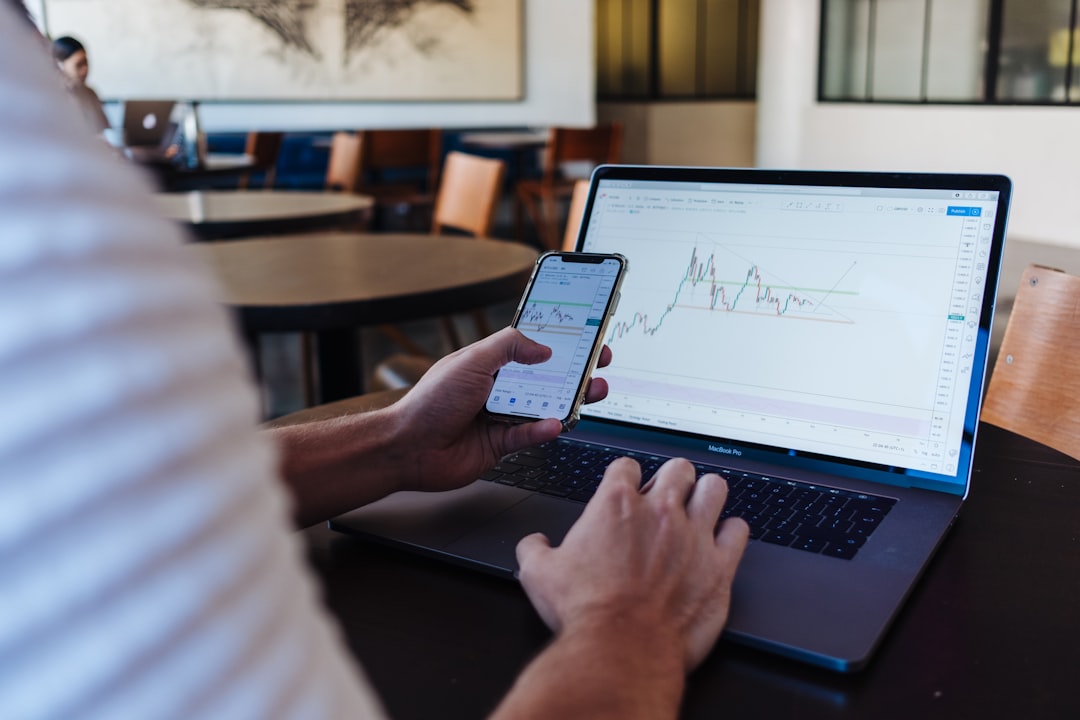
Photo by Jason Briscoe on Unsplash
The Exchange Spread Mystery
Last Thursday afternoon, Bitcoin was trading at $42,150 on Coinbase while sitting at $42,320 on Kraken. A $170 difference on a single asset. For most people scrolling through their portfolio app, this is noise. For a specific breed of crypto trader, it's a silent alarm bell signaling free money.
This phenomenon—price discrepancies across different exchanges—has existed since the first crypto exchange went live. Yet it remains shockingly underutilized by retail traders who'd rather obsess over the next meme coin than exploit something mathematical and reliable. The arbitrage opportunity persists because it requires patience, technical setup, and a willingness to accept smaller profits than swing trading might promise.
How the Math Actually Works
Here's where it gets practical. Imagine you spot Ethereum at $2,240 on Gemini and $2,310 on Binance US. You purchase 10 ETH on Gemini for $22,400. You transfer it to Binance US (taking roughly 12-30 minutes depending on network congestion) and sell those 10 ETH for $23,100. Subtract the $15-30 network transfer fee and you've just made $655 on a transaction that required zero market prediction.
The catch? You need enough capital to make the spread meaningful. A $30 profit might sound laughable until you realize some traders execute 5-10 of these cycles daily. A trader with $50,000 can reasonably capture $150-300 per trade. Over a month, that compounds into material returns with significantly lower risk than traditional trading.
The real sophistication comes from understanding which coins create the largest spreads. Lower liquidity altcoins often show 2-5% differences across exchanges. Bitcoin and Ethereum, being heavily traded everywhere, might only show 0.1-0.4% gaps. The spread size is directly proportional to how few people are buying and selling on any given exchange.
Why Spreads Still Exist in 2024
You might reasonably ask: if this is so obvious, why hasn't the spread disappeared? Efficient markets theory suggests arbitrage opportunities vanish instantly as traders compete to close them. Crypto proves this theory isn't absolute.
First, there's friction. Moving money between exchanges takes time, involves withdrawal fees, and requires managing multiple accounts and security protocols. For someone with $2,000, these costs eat the entire profit. Second, not everyone has simultaneous access to all exchanges. Geographic restrictions mean someone in Europe might not trade freely on certain US-based platforms. Third, price moves fast. By the time you transfer your coins to capitalize on a spread, it might have closed or reversed.
Perhaps most importantly, the people who could execute this at scale—algorithmic traders and institutional firms—have largely moved beyond exchanges to trade directly with market makers using APIs. They've migrated to more profitable hunting grounds, leaving small spreads on public exchanges for patient retail traders to capture.
The Tools That Make It Viable
You don't need anything exotic to start. Services like Coingecko and CoinMarketCap show real-time prices across exchanges, though they lag by a few seconds. More serious practitioners use paid data feeds from Bloomberg Terminal or specialized crypto analytics platforms that update prices every second.
The infrastructure piece matters. Top-tier arbitrageurs use API connections to withdraw from one exchange and deposit to another simultaneously, eliminating wait time. Some use "atomic swaps" or cross-chain bridges to move assets instantly. Others maintain deposits on multiple exchanges at all times, ready to execute when spreads appear. This means accepting some opportunity cost—your capital sits idle on exchanges earning nothing until an opportunity emerges.
A trader in Austin recently described their setup: four exchange accounts monitored through a custom Python script that alerts them when any spread exceeds 0.5%. They keep roughly 25% of their trading capital spread across four platforms at all times. When an alert fires, they have 60 seconds to execute before the spread closes. Over six months, they captured roughly 6% returns with minimal volatility, far steadier than most crypto traders manage.
When Arbitrage Becomes a Problem
Regulatory eyes are starting to focus on cross-exchange trading patterns. The SEC has questions about whether certain arbitrage strategies constitute market manipulation when executed at scale. The CFTC is examining whether coordinated arbitrage across derivatives and spot markets creates systemic risks.
For retail traders, though, this remains completely legal and above board. You're not manipulating prices or using insider information. You're simply capitalizing on temporary inefficiencies created by geography, regulation, and friction.
If you're interested in how exchange mechanics create hidden value, you might also want to understand staking's hidden costs and true economics, which involves similar hidden spreads in DeFi protocols.
The Unsexy Reality
Arbitrage won't make you wealthy overnight. It won't get you featured on crypto Twitter. You won't have a cool narrative about beating the market through superior analysis or timing. What you will have is steady, boring returns that compound quietly while traders around you either strike gold or lose everything chasing volatility.
The best-kept secret in crypto isn't a new blockchain or a celebrity-backed token. It's that mathematical inefficiencies still exist, hiding in plain sight on the exchange listings everyone sees but few actually study. The question isn't whether these opportunities are real. It's whether you're patient enough to capture them.
Comments (0)
No comments yet. Be the first to share your thoughts!
Sign in to join the conversation.