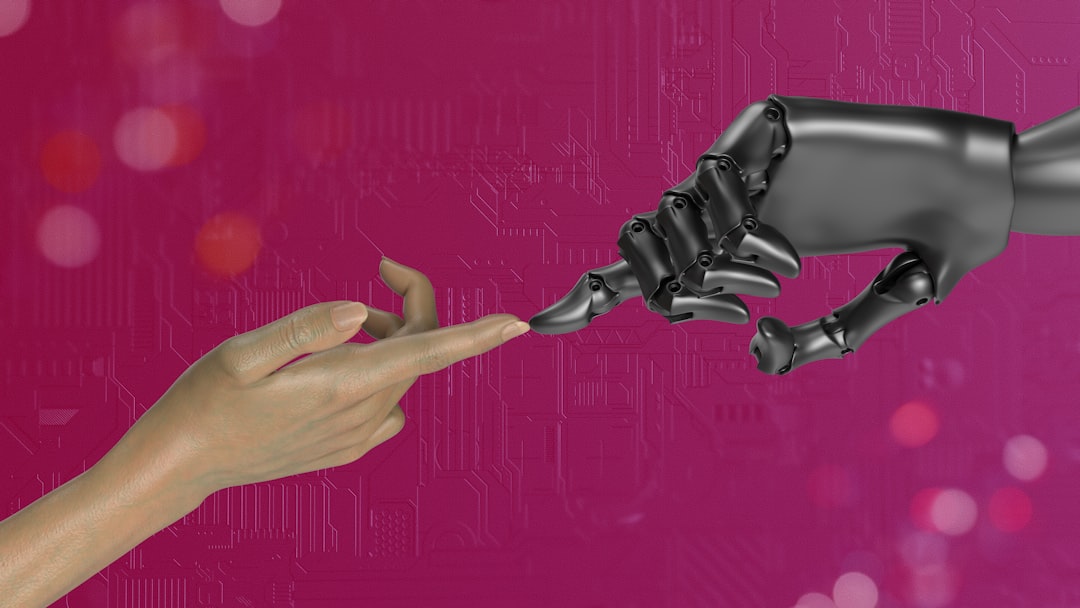
Photo by Igor Omilaev on Unsplash
Last year, a researcher at OpenAI noticed something odd. When they asked GPT-4 to solve a complex math problem, the model didn't just spit out an answer. It paused. It wrote out its reasoning. Then it caught its own mistake and corrected itself. No human told it to do this. It learned to second-guess itself.
This moment represents something fundamental shifting in how AI systems work. We're moving away from the era of models that output answers with unshakeable confidence toward systems that actually think through their reasoning, spot their own flaws, and adjust on the fly. It's messy. It's inefficient by some measures. And it's dramatically improving how well these systems perform.
The Problem With Confident Machines
For years, large language models operated like overconfident students who never doubt themselves. You'd ask them something, and they'd generate an answer with such fluidity and certainty that you'd believe it, even when it was completely wrong. This phenomenon has a name now: hallucination. The model generates plausible-sounding information that has no basis in reality, and it does so with absolute conviction.
A famous example: a lawyer once used ChatGPT to research case law for a court filing. The model confidently cited legal precedents that simply didn't exist. The lawyer got embarrassed. The AI wasn't lying—it was doing what it was designed to do: predict the next word based on patterns in its training data. When predicting legal citations, the patterns sometimes led to invented cases that sounded exactly like real ones.
The root cause is architectural. Traditional transformer models (the technology behind most modern AI) have no built-in mechanism for uncertainty. They can't say "I don't know" because they're not actually reasoning through problems. They're pattern-matching at superhuman scale. For straightforward tasks like writing emails or generating creative content, this works fine. For tasks requiring accuracy, it's a disaster.
That's where self-critique enters the picture.
Teaching AI to Be Its Own Skeptic
Self-critique works roughly like this: you give the model a task, and instead of asking for just an answer, you ask for reasoning, then ask it to review that reasoning. You prompt it to find flaws. You ask it to reconsider.
A team at Google Brain tested this in 2023. They created a system that would generate an answer to a question, then explicitly ask itself: "Is this correct? What could be wrong?" The results were striking. On certain benchmarks, accuracy improved by 15-30% just by adding this self-reflection step. The model would catch math errors, logical inconsistencies, and factual claims that needed verification.
One concrete example: when solving word problems, models with self-critique would compute an answer, then trace backward through their work. "If there are 5 apples and I remove 2, I have 3 left. Does that match what the problem asked for? Yes, the problem asked how many remain. My answer is consistent." It's not revolutionary thinking, but it's genuine error-checking.
The mechanism isn't magic. Researchers essentially trained models on examples where reasoning was included, where mistakes were pointed out, and where corrections were made. Then they let the models practice this pattern at scale. Some systems even learned to use external tools—calculators, search engines, knowledge bases—to verify their claims before finalizing answers.
Why This Matters More Than It Seems
Self-critique is reshaping what AI can actually do in real-world applications. Consider medical diagnosis systems. A self-critiquing model might suggest a diagnosis, then ask itself: "Am I confident in this? What alternative explanations should I consider? What information am I missing?" This isn't replacing doctors—it's creating a more thoughtful AI partner.
In software development, code-generation models (like GitHub Copilot) are starting to incorporate self-critique. They generate code, then review it for bugs, inefficiencies, and security vulnerabilities. Early versions caught approximately 40% more issues than versions without self-review.
The implications extend to accountability and transparency. When an AI system shows its work and questions itself, humans can actually follow the reasoning. You can see where it might have made an error. This matters enormously for regulatory compliance, especially in finance and healthcare where you can't just trust the black box.
Of course, self-critique isn't a cure-all. A model can confidently critique itself incorrectly. It can reinforce its own false beliefs. And as I've discussed elsewhere, hallucinations remain one of the most persistent challenges in modern AI systems. But the combination of self-critique with other techniques—like retrieval-augmented generation (pulling in external facts), ensemble methods (asking multiple models), and fine-tuning on high-quality data—is creating measurably more reliable systems.
The Emerging Pattern
What's fascinating is that this mirrors human cognition. Good thinkers don't just generate answers—they question them. They consider alternatives. They look for flaws in their reasoning. We're now training AI systems to do something analogous, and the results suggest this approach is scalable.
The next frontier is making this process more efficient. Current self-critique models sometimes use twice as many computational resources because they're essentially thinking through problems twice. Researchers are working on ways to make this reasoning more targeted—having models flag when they should second-guess themselves versus when they can confidently proceed.
We're still early in this shift. But the trajectory is clear: the future of AI isn't just smarter models. It's smarter models that know how to be skeptical of themselves. In a field built on pattern-matching and probability, that's surprisingly profound.
Comments (0)
No comments yet. Be the first to share your thoughts!
Sign in to join the conversation.